
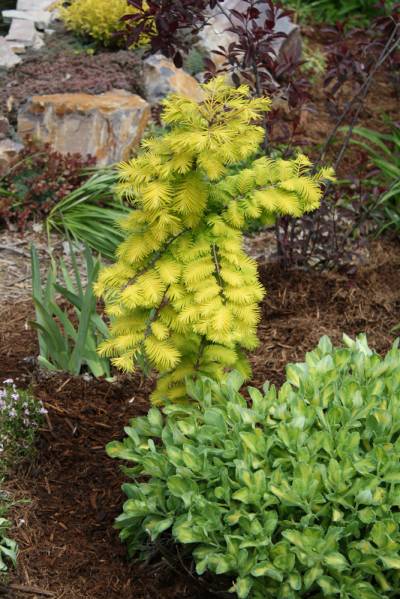
Dawn Redwood: Metasequoia glyptostroboides ‘Gold Rush’
May 16th, 2010In addition to the cedar I bought yesterday, I also bought a seqouia, a redwood, for here in Michigan. Crazy you say? Well, apparently, notsomuch.
What gardener doesn’t dream about having a massive redwood in their yard, and if we could live for a thousand years we might be able to get one, but instead I guess we must just relinquish ourselves to younger versions of the trees, which yes, you can grow outside of California.
There are three species known as redwoods or sequoias. Sequoia sempervirens or Coast Redwood, is the tallest known tree in the world and is the one you think of when you think of giant redwoods. The Sequoiadendron giganteum or Giant Sequoia is also one of the biggest trees and while there aren’t any known ones taller than a coast redwood, they are the biggest, by volume, trees in the world.
The third one, the one I bought is Metasequoia glyptostroboides or Dawn Redwood which I will call ‘metasequoia’ because I hate typing the rest of it out. I paid $32 for it, a 3 footer in a 1 gallon container. Got it from Gee Farms here in Michigan.
Metasequoias were thought to be extinct. There are fossil records of them all over the world, but no known survivors were located until 1944 when they were found growing in a secluded valley in china. It has since been exported for gardeners to grow all over the world. It is perhaps a good ecological choice to grow too, considering how close to extinction it is.
It is the smallest of the lot, alas, topping out, it is believed, at 200 feet (in many many years) but like it’s relatives it is a very fast grower to 50 or 100 feet. The fact is we just don’t know how big this tree can get because we have no 1000 year old samples to check out.
It is also the hardiest of the three. I have seen reports of it being hardy in zone 6, or 5, but quite a few sources stating zone 4, including some university sources which I consider to be accurate. Coast redwoods are the least hardy, but Sequiadendrons will supposedly take zone 5 (until you get a really really cold winter I suppose).
Sheltering and putting it in a microclimate such as on the south side of a hill where it will be protected from northern winds will probably help. Additionally, it needs full sun, so a hill is good there to, and it needs lots of water, so the base of a hill is also usually pretty damp. I do not have a hill, so it is going in my backyard. However I also bought a couple for my parents, and they have a hill (and are almost zone 4) so I told them to plant it as I described above.
There are a variety of Metasequoia cultivars now, many of which do not grow as fast as the species variety. The one I bought, ‘Gold Rush’ is supposed to grow as fast or only slightly slower, so that is good. It also has striking golden foliage which it is supposed to keep all year, which is rare for a sun lover. I like designing with contrasting foliage colors so this is a good choice for those applications.
Like a bald cypress (a cousin) the plants are deciduous conifers, so they lose their needles in the winter and go dormant (which probably aids their hardiness). Also like a bald cypress, they develop gorgeous trunks when older, which have to be my favorite feature of the plant. Corded, complex, reddish trunks, very pretty.
I have a small yard, and if my house still stands in 200 years the tree will probably be too big. But whomever the current owner is I suppose can always cut it down and use the valuable wood to build a deck or something.
In the meantime I will enjoy, consequently, I also think they may do well as bonsai. I have a dream of going out and planting cuttings on public land near my house, which should be preserved forever. So in generations there will be some huge trees growing there, my footprint on the future.
Himalayan Cedar: Cedrus deodara ‘Karl Fuchs’
May 15th, 2010My recent post about what a real cedar is was not a coincidence, I have been looking at buying one, and today I did.
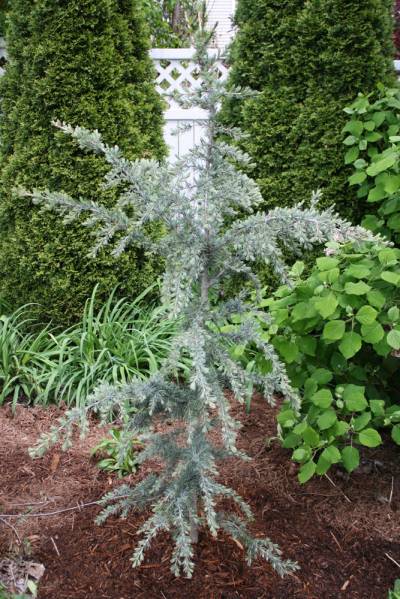
I have wanted a cedar for years, even since I saw Paul James’ on his show. Paul has a weeping Blue Atlas cedar, Cedrus atlantica, and it is absolutely gorgeous… and not hardy in zone 5. No matter how often I now see HomeDepot or Lowes carrying it, it is not hardy here. Now… perhaps in a microclimate it might survive, a courtyard, or if you give it serious winter protection, but it really needs zone 6.
However in doing some research I discovered another variety, Cedrus deodara the Himalayan cedar, that is more cold hardy and one specific cultivatar, ‘Karl Fuchs’ definitely so. It is blue, which I wanted, not as blue as the atlas, and the needles aren’t quite the same, but I’ll make do. It is my only choice really, so I have to don’t I?
Anyways, I really like these true cedars. They have very short and tightly packed needles so you really see a lot of the tree structure. As my gardening tastes have evolved I find myself attracted more to the form or structure of plants such as in Japanese gardens where the stem or trunk and branching is as important and beautiful as the foliage.
So the cedars, with their short needles that cling in clumps to the trunk and branches, really show off the form, and it is a unique look for the garden. I wanted one specifically for the spot in which I planted it. In that area of the garden I’ve got a Japanese maple with red foliage, some yellow heucheras, and all sorts of green plants, but not a single plant with blue foliage. The closest plant with blue foliage was probagly 40 feet away, and using contrasting foliage colors in the landscape is always a good idea, so I needed something.
They do need some care to make sure they survive, even if they’re supposed to be hardy. The reason evergreens can survive the winter isn’t just because they handle the cold, but because their needles have adapted to handle the dryness. Winter is the dryest season, cold winter sun, drying winter wind, air without any humidity to it, it all takes a toll on plants. Most evergreens have a waxy coating on their needles or foliage to help prevent moisture loss and it is this that allows them to be evergreens. When an evergreen gets dried out it is called winter burn and you’ll notice it as a browning or bronzing of the leaf tips or exposed sections of the plant.
Well, cedars are less able to deal with these stresses than other evergreens, they just evolved where the winters aren’t so cold and dry.
So they need protection from the winter sun, and need protection from the winter wind. I have a very sheltered backyard with the house to the west and big trees pretty much all the rest around the perimeter. So my backyard is relatively low on wind, and I planted this Cedrus deodara on the north side of a large spruce which should protect it fully from the winter sun. I may also do a loose burlap wrap this winter to help it too. You might think that a plant that is marginally hardy in your area might do better with a southern exposure, and in most cases you would be correct, because it is warmer on a southern exposure, but for evergreens, especially Cedrus, the sun is more damaging than the cold.
If I have any problems with the tree in the future I will be sure to post an update, if anyone has any tips for growing one in z5, please leave a comment.
Now you Cedar, Now you Don’t
May 12th, 2010I have a peeve, and thy name is Cedar. Or is it?
People are confused, I was confused, confusion abounds, what is a cedar? What isn’t? I’ve even seen articles, writing by some sweatshop overseas writing shops I’m sure, that are completely mishmashed confusing true cedars with fake ones. That is the quality you get I guess when you pay by the word at one of these generic article spam sites, and don’t give any bonuses for accuracy.
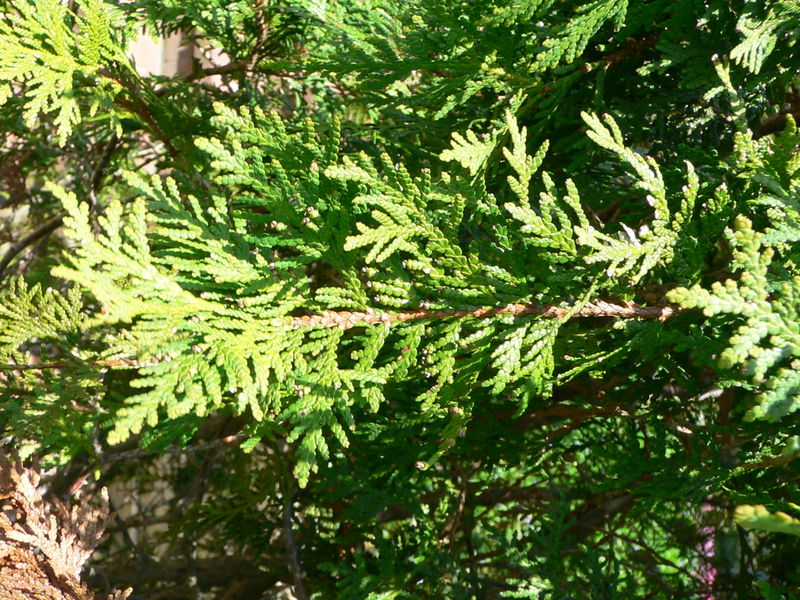
A Thuja, not a Cedar
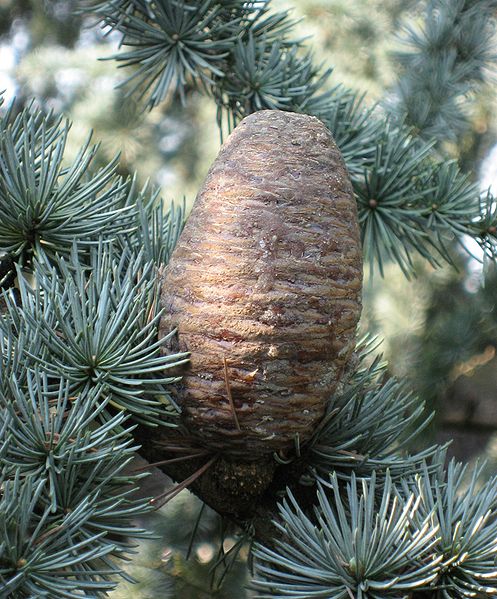
A True Cedar
Anyways, what I mean to say, is that what you think is a cedar, probably isn’t. If it is native to North America, it isn’t a cedar, if it is growing in zone 5 or colder, it probably isn’t a cedar (though, there are a few exceptions).
True cedars have the genus cedrus and are native to North Africa, the Middle East, and regions around the Himalayas. If it isn’t a cedrus it isn’t a cedar.
Eastern Red Cedar
Eastern Red Cedar, the most common non-cedar cedar. Is what most people in North America think of when we think of the word cedar. This tree is native to most of the eastern US and Canada. It is evergreen, has blue berries (not cones) and scaly green leaves, not needles. The scientific name of Eastern Red Cedar is Juniperus virginiana for you see, it is a juniper, not a cedar.
However, if you want to be really confused. This is the tree that gives us the smelly and rot resistant “cedar” wood we all know and love, but again, it isn’t an actual cedar.
Western Red Cedar
Western Red Cedar also produces aromatic and rot resistant wood. It grows larger typically than the Eastern Red Cedar. It is a conifer, producing little cones as opposed to the berries found on the Easter Red Cedar. The scientific name of Western Red Cedar is Thuja plicata for you see, it is a thuja, not a cedar.
Western Red Cedar can also sometimes be called Arborvitae, which at least, is accurate if generic.
Northern White Cedar
Northern White Cedar is a tree which is again native to the Eastern parts of North America, it has cones, often starting yellowish before maturing, and scaly leaves again. It is, of course, not a cedar, but another thuja, Thuja occidentalis specifically. It is also often called Arborvitae. The lumber of Northern White Cedar is often used for log cabins and the like. It also has very many cultivars and is widely planted in landscapes.
So what is a cedar?
A cedar has to be in the genus Cedrus there are only a few types, worldwide: Cedrus atlantica or Atlas Cedar; Cedrus libani or Lebanon Cedar; Cedrus deodara or Himalayan Cedar. Others just aren’t true cedars. Additionally, most non-cedar cedars are the type of evergreen with scaly leaves, not needles. Cedars have needles. So an easy way to remember if it is a real cedar or just pretending, is if it has needles or not.
True cedars are very unique looking plants and make excellent specimens if they can grow where you live. They generally need mild winters (most can’t live in zone 5 or colder, there are a handful of exceptions) and shelter from drying winter sun. They certainly look nothing like the false ones most people think of.
Your Garden, The Most Local Food of All
April 25th, 2010I’m sure I’m not the only one who has been exposed to the new green trend of “eating local.” The idea behind the movement is that food that is transported less has less of a “carbon footprint” and it is also good to support your local community.
That is all well and good, but as with any “green” thing you sometimes have to wonder if they’re just doing it for the money. Marketing their food as local as a way to sell more of it.
Because, you see, I think that if someone were really advocating for local food they’d recommend the most local food of all, your garden.
Something Trendy This Way Comes
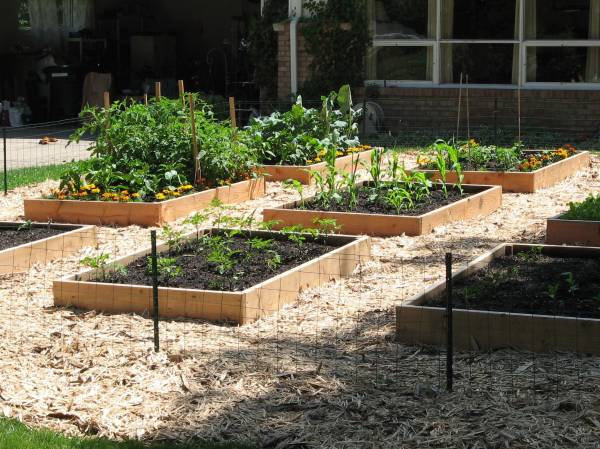
Front Yard Farming
Gardening is becoming more and more popular lately, especially edible gardening. I think it is a perfect storm of the green movement and the recession that has made people think that they will grow their own food to save money.
Just in my little neighborhood I’ve noticed two people put in front yard vegetable gardens. Yes, they are sacrificing their lawn and curb appeal for a fenced in utilitarian vegetable garden, and that is just front yards, I’m sure many more did as much in their backyards where I can’t see.
In a way a front yard farm, as I like to call it, is a beautiful thing in it’s own way, because it is an advertisement for something simple and easily to do, and that if everyone did it, I’m convinced the world would be a better place.
So, Why Grow your Own Food
There are four reasons to grow your own food.
1. It tastes better, seriously. Bananas ripen off the tree and get better with age, but many many foods start losing flavor and sweetness as soon as they’re picked, and also benefit from being allowed to fully ripen on the tree or plant (at which point they’d be too ripe to ship, so you wouldn’t find them in stores).
2. It is better for you. Just as plant flavors change, the nutritional profile does too, almost without fail produce that is fresher has more vitamins and minerals than stuff even a few days old.
3. You save money. You don’t always save money right away, because of the startup cost of starting a garden, but in the long term you certainly do, and with some times like an apple tree the savings can be enormous.
4. You get more variety. At the store your options are limited, even at the most well stocked grocery store. But the variety of available seeds for your planting at home is far larger.
So… how to get started
I’ve written a bunch of articles that should hopefully get you started in growing your own food.
Fall is for Planting Fruit
Grow Potatoes in a Trash Can
Garden for Dollars, Grow Asparagus
How to Build a Raised Bed Vegetable Garden out of Wood
How to Build a Hoop House for Frost Protection
Growing Raspberries
Edible Ornamentals
In addition to all of those, I have compiled guides to growing over 100 different specific food crops, you can find that full list here.
That should get you started, and if you want any help in planning your foray into edible gardening you can post in the forums attached to this site, or comment here. And remember, you don’t need a lot of room to grow some of your own food. You can plant a dwarf apple tree that’ll produce a couple bushels a year in a space as small as 4×4.
Split Trunk Repair Update
April 10th, 2010Last Fall my favorite tree, a forest pansy redbud, was damaged in a wind storm and ended up with a split trunk. In that linked to blog post I detailed my methods for fixing the damage.
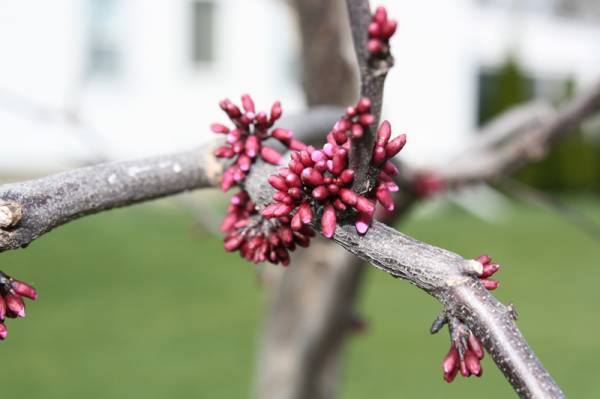
The tree made it through the winter and both halves are still alive, but growing at different rates.
Below you can see the flower buds from the winning half of the tree. They’re fully swollen and will open any day now.
The other half of the tree, the half that had fallen down and that now has less trunk attachment, it is growing, and is alive, and is still reattached as I made it, but it is growing slower. In the below picture you’ll notice the buds barely growing out of the branches.
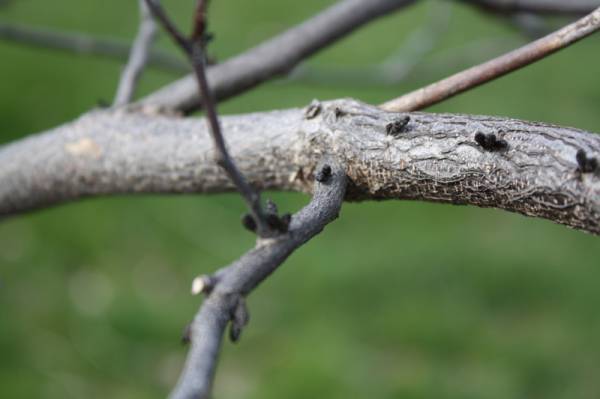
These pictures were of course taken on the same day. Obviously I think the amount of cambium left attaching the weak side of the tree to the trunk is unable to fully support it at a normal growth rate, or at least, at the same growth rate as the strong side of the tree. I may need to do additional pruning on the weak side until I reach an equillibrium between the growth and it’s energy supply. But, regardless, the tree lives, and that is the important thing.
Apricot Tree Update
April 10th, 2010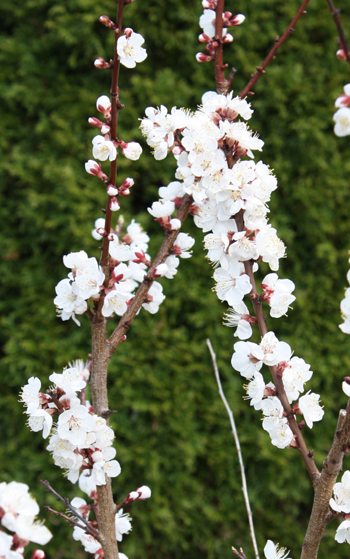
A year ago I planted an apricot tree I had ordered from Stark Bros. I ended up making a post about it to rave about the quality of the bareroot tree I was sent, it had almost perfect branching.
I mentioned in the post that with such nicely pruned branching the tree could fruit sooner than normal, perhaps as soon as two years.
Well, it is covered with blossoms right now, and typically blossoms mean fruit. Sometimes when a fruit tree is young it will fruit only on a few small areas of branches, and that doesn’t necessarily mean fruit, but for every other fruit tree I’ve grown, being fully blossomed like this means fruit later this year.
Also odd is that some of the blossoms are coming directly from the trunk and or primary branches, making me think this may be a spur-type plant, (that fruits from primary or secondary branches, instead of tertiary ones) but it was not sold as such.
This is, however, the first apricot I’ve ever grown so maybe it is a normal thing for the tree. Anyone have an opinion on that?
In anycase, the tree is still certainly performing mightily.
My New Mini Greenhouse
April 3rd, 2010One day I will have a nice big real temperature controlled greenhouse, I swear it. But for now, I don’t have one, nothing even close.
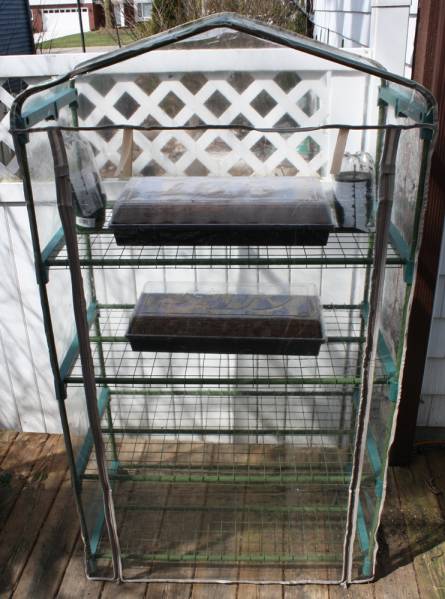
At Lowes the other day I saw something and made an impulse purchase, but I’m glad I did, because I really could use this product.
Basically it is a metal and plastic frame about 6 feet high with shelves on the inside and a thick clear plastic sleeve ont he outside that zips open. It cost me only $40.
I don’t have a single window in my house that faces south. I also have cats, and babies, and so I don’t have a lot of space for indoor seed starting, with window light or artificial light (and personally, artificial light never seems to produce good plants for me).
This box however has all the room I need to start seeds, more than enough really. The thick plastic really holds in heat, when I unzipped it after I had it in the sun it felt like opening a sauna door. I’m not sure how much freeze protection it’ll give, but it will at least give some protection, and I can always bring in the plants overnight if needed. Because it is mobile too I can always wheel it around to optimize sun protection and shelter. There are microclimates in my yard and putting it in one of my warmest microclimates should help compound the protection the plastic provides.
Only one problem, wind. After I set it up and planted my seeds a few hours later I go out and it was on it’s side. I knew this would be a problem, so I had set it up for a week without any plants to see if it’d tip, it didn’t, great. But after adding seeds I did move it to get more sun and that probably opened it up to more wind.
The solution is to relegate the bottom shelf to holding some concrete pavers. Now it is weighed down enough where I’m confider the wind will not hurt it.
All told, I’m pleased with the purchase, it is just what I needed. I can use it now for seed starting, and later for propagation when I need to control humidity, and it was only $40.
First Flower of 2010
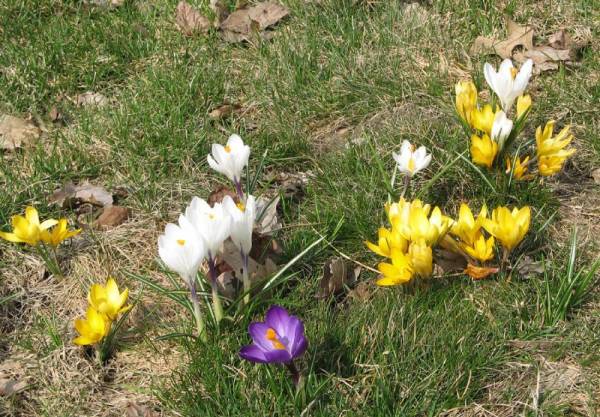
March 17th, 2010 In 2009 my first bloom was a yellow crocus on March 15th 2009.
This year my first bloom was a yellow crocus on March 16th 2010, though, in a different location.
That is pretty good consistency, though, last Spring it was really cold through the balance of March and April, hopefully we do not have a repeat.
My lilac already has almost-leaved-buds on it. Most other things have swelling buds, tulips are coming up, onions from last season are well up. So far, so good. In some years I’ve not had my first blooms until April, last year I was excited by the early blooms, but then the cold came. Hopefully this year mother nature isn’t merely being a tease.
Garden Photo Contest
February 3rd, 2010Holland Bulb Farms is having a garden photo contest. And no, not getting paid to tell you this (I wish) just thought I entered so others might want to too.
Go and enter your own, or just vote for mine. Please?
They allow you to upload as much as 10 at a time, but when I tried to do 10 it got busted, one file got corrupted, and a bunch didn’t load. Do them one at a time to be safe.
A Dream of Spring
February 2nd, 2010All Nature seems at work. Slugs leave their lair –
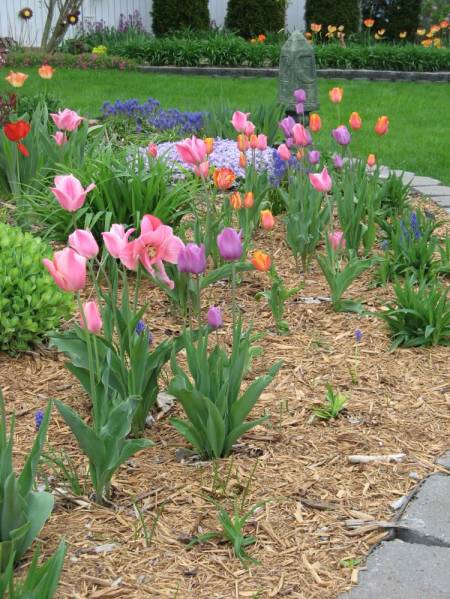
The bees are stirring -birds are on the wing –
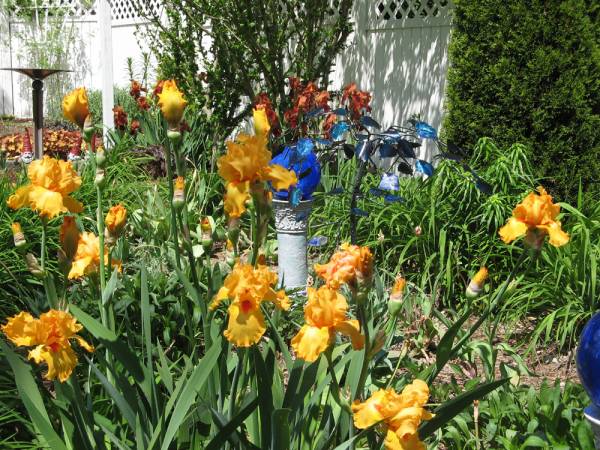
And Winter slumbering in the open air,
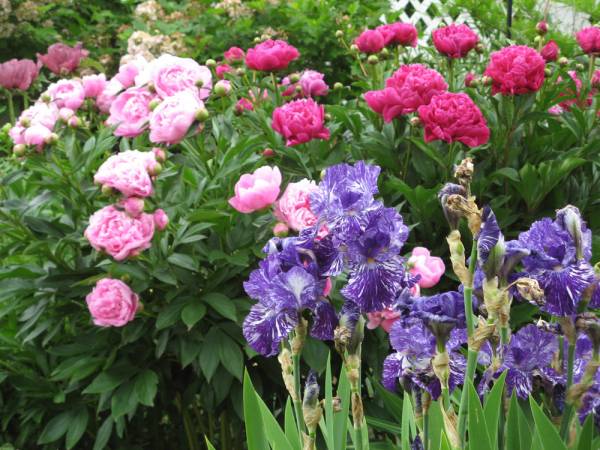
Wears on his smiling face a dream of Spring!
And I the while, the sole unbusy thing,
Nor honey make, nor pair, nor build, nor sing.
Yet well I ken the banks where amaranths blow,
Have traced the fount whence streams of nectar flow.
Bloom, O ye amaranths! bloom for whom ye may,
For me ye bloom not! Glide, rich streams, away!
With lips unbrightened, wreathless brow, I stroll:
And would you learn the spells that drowse my soul?
Work without Hope draws nectar in a sieve,
And Hope without an object cannot live.
Remember all, winter can’t last forever. Are your green thumbs feeling itchy yet?