
Barberry, a great shrub for the landscape
June 10th, 2007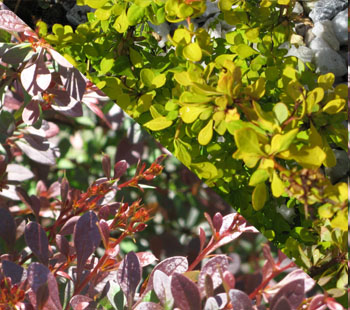 There is something to be said about barberries. They do not have beautiful flowers. Their scent can be bad. Their foliage, though nice, is beat by other plants. And yet I find myself thinking of them as one of the best bushes for the landscape.
The reasons? Sheer growability. Japanese Barberry (Berberis thunbergii) are hardy to zone 4, can take sun or shade, wet or dry, and will come back strong after a beating. We had one growing up along our foundation when we had new siding put on. Because of the thorns I needed to remove it so the workers could do their thing. I cut it down, and since I was too lazy to dig it up (it was quite mature) I just attacked it’s root ball with an axe and left it covered with debris. It was stepped on and worked on for months… and the plant came back and grew to 4 feet the next year. Any plant that can take that kind of abuse cannot be all bad.
Critters also will not eat barberry. It has been used as a herbal medicine and apparently it has a very bitter taste. I know it’s yellowish wood certainly does not look appetizing. So it is either from the taste, or the aforementioned spikes, but deer & rabbits leave it alone, and I mean that. I know in many gardening catalogues I’ll read “Deer tend to avoid.” and think its BS because I’ve seen deer eat that shrub before, but if anything is truly critter resistant, barberry is.
Most barberry you will find in nurseries and garden centers will be of the burgundy variety, and thats great. It is important to use contrasting colors in garden design and Barberries are a great reddish plant to use. However, there exists a newer variety that has yellow tinged foliage (pictured, along with a red variety). This variety is harder to find but with both a red and a yellow barberry you have all sorts of planting options available to you.
If there is one bad thing about barberries it is that they are deciduous, no winter interest except for a few small berries that the birds quickly eat. Though maybe further south some variety stay everygreen I hear.
So, they aren’t really standouts in any particular category, but they can be grown more or less by everyone, in almost any location, and can provide 2 nice non-green foliage colors to liven up your landscape. All that together makes them a great choice for your yard. My only word of advice would be to not plant them too close to paths or windows. Paths because of the thorns, and windows because their flowers are a little pungent (though you have to get really close to smell them).
Nature Hills Makes Good
May 28th, 2007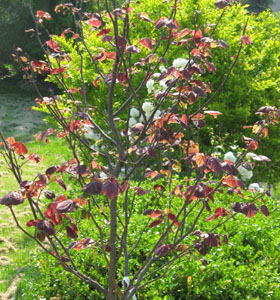 Last Spring, well over a year ago, I purchased a ‘Forest Pansy’ redbud from Nature Hills Nursery. It didn’t bloom that first year, so I couldn’t confirm bloom color, and the leaves were green, instead of the purple they are supposed to be. I gave it the benefit of the doubt though and thought maybe the bad colors were because it was a young tree. Well this Spring it bloomed and the blooms were white so I know I had the wrong tree, what I had was probably a ‘Royal White’ redbud, which is a fine tree, but not something I wanted. My siding is white, my fence is white, so I don’t much like white flowers since they do not pop in my landscape.. I called Nature Hills and they promptly made good on their mistake.
Initially they offered to send me a new tree, but I wanted a bigger one so I went to this large tree farm around 30 minutes away that had one and bought an 8 foot specimen. So I took store credit from Nature Hills instead and got some hostas.
Nature Hills did not require I know my order number, have my receipt, or send the tree back, though they did request a picture of it. I ended up giving it to a neighbor in exchange for a bag of homemade cookies.
I am extremely pleased with the tree. Granted, I haven’t been growing it long, but man the leaves are a nice color. They aren’t the crimson of a Japanese maple, or the deep burgundy of other red maples or barberries or heucheras, they definitely have a purple quality to them. Its a shade of red I cannot find in any of my other landscape plants.
My New Plant Wish List
May 12th, 2007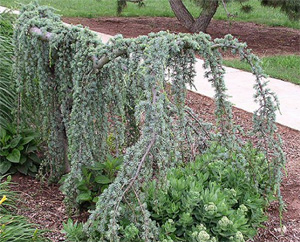 Late last Winter I posted a plant wishlist and I thought it’d be fun to do one again.
I still haven’t gotten an American Beautyberry with it’s wonderful purple berries, so that is still on my list.
Luckily or unluckily I did have a tree die, and I so bought my ‘Forest Pansy’ Redbud, so far I am very pleased with it. Pink flowers in Spring and interesting foliage.
I tried the Blue Himalayan Poppies. I tried seeds and couldn’t get them to grow, I tried mail order and the plants died (but in the plant’s defense, I mostly blame the nursery).
I no longer want too badly the iceplant I mentioned. I think I’m off my iceplant kick. I really like how much they bloom in summer, but their Winter hardiness here is hit and miss it seems. The only one that really does well, the hardy yellow one, blooms the least.
Now… I did have a longer plant wishlist, but I put in a new bed in the front yard already this Spring and have got a lot of my list filled in. I bought a variegated 10 foot tall variety of miscanthus, I bought some ‘Color Guard’ yuccas, I bought ‘Fanfare’ Gaillardias, and finally some ‘Kopper King’ Hibiscus. All of those plants I really wanted, I recommend them all, and they all look great.
I also wanted some more ‘Endless Summer’ Hydrangeas they are such great landscaping plants. So I bought 6 more to make a nice little hedge in my new bed, I can’t wait until they’re all in bloom.
However… one plant has really been on my mind for a long time, but I didn’t know I could grow it. Weeping Blue Atlas Cedars (Cedrus atlantica ‘Glauca Pendula’) are absolutely gorgeous. They have brilliant blue needles and a most interesting growth habit. I fell in love with these trees when I first saw Paul’s on ‘Gardening by the Yard.’ However, I always thought I couldn’t grow them here because they are only hardy to zone 6 and I am in zone 5. There is a nursery though around here, supposedly the largest on in Michigan, and they have some which they saw they overwintered here. I need to find out what kind of protection they used, to see if I could replicate it, but I really wanna try. These trees are just gorgeous. I’ll have to remove a butterfly bush to make room for it, but the butterfly bush only gives interest a few months of the year (July-October maybe) whereas this will be year round. Plus, I’ve got 2 others.
Beware the Chocolate Mulch
May 12th, 2007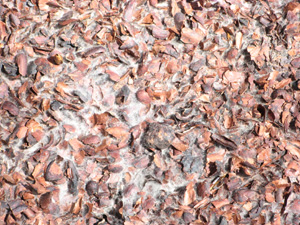 It sounds good on paper. Cocoa bean husks used as mulch, get use out of a waste product, smells nice as you walk by. I’ve seen this mentioned on websites and on TV shows. But I have never seen it in a store.
This Spring through I saw a bunch of bags at Meijer and decided to try one. It does smell like chocolate, unfortunately its almost useless as a mulch.
One week outside with a few days of rain and it turned into a clotted moldy mass with the consistency of a brownie. I’m not adverse to seeing various types of fungus showing up on mulch, its just doing it’s thing turning it into compost. This mold though, it was a sickly bluish white color, looked more and smelled more like bread mold or other mold you find on something lost in the back of your refridgerator. Plus, it only took a week to get like that. Usually it takes a full year for wood mulch to get clumpy like that. So I had to pick it all up and compost it, didn’t seem like a great thing to be growing basil in, plus I also noticed atleast one critter was getting into it.
So, be warned, cocoa bean husk mulch is a bad idea.
Use Water Crystals for More Flexible Plantings
May 6th, 2007Plants should be planted with similar plants that have the same soil, light, and watering needs. You shouldn’t plant a water loving plant like a hardy hibiscus (rose mallow) next to a dry loving plant like a yucca or sedum, or should you?
Well, there is a way to do this. Something I’ve just started to do. You need to be able to make the water moist only around the plants that need it. Obviously this can be done with spot watering from a can, but that can also be a hassle. A better solution is to just water the entire bed normally, make sure it has good drainage, but then around your water loving plants put the new water absorbant crystals.
Water absorbant crystals, crystals that swell up and store water then slowly leak it back out, are not a really new product, they’ve been around for a few years. However they are mostly relegated to potted plants, some potting mixes even have them already mixed in. And don’t get me wrong, they’re awesome for potted plants, especially hanging baskets that can be hard to water. However they’re also great for garden plantings as well.
Chances are we all have a plant in our landscape that needs more water than most other plants, and we all probably water when this plant needs it, rather than when everything else needs it. Or, this plant doesn’t get as much water as it could use, and so has stunted growth.
You can remove the mulch from around said plants, and sprinkle these crystals on the soil, then reapply the mulch. Additionally you can add them directly to the hole the next time you’re planting such a plant.
Often too, plants that need lots of water, tolerate lots of water. So you don’t really need to worry about overdoing it. Water loving plants like canna lilies or bald cypresses can grow in standing water (and love it) so perpetually damp soil isn’t going to rot their roots. Other plants that need large doses of water include hydrangeas (especially those with sun exposure), the aforementioned hardy hibiscus, grape, pumpkin, cucumber, gourd, and really most other plants with large leaf surfaces (the larger the leaf, the more moisture is lost during the day).
With these crystals a little goes a long way as well, you can do hundreds of square feet of garden with a single bottle. If you cannot find them locally, Amazon sells them.
New Park Seed Bonus Code
May 1st, 2007Use this at parkseed.com, its a pretty good coupon, one the better ones I remember seeing them release. Save 15% Off Entire Order at Park Seed – Enter Coupon Code MAY15 at Checkout. Hurry Offer Expires May 31,2007 SAVE NOW!!
Also, use code RAINBOWKO to get a free Rose Rainbow Knock Out.
Stop Rabbits (and Deer) from Eating Shrubs in Winter
April 30th, 2007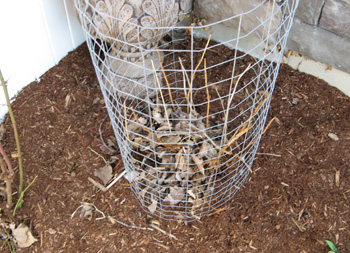 This isn’t the most timely advice, it would be best in the Fall, but I’m posting this in Spring because it is on my mind. Also because I noticed a lot of my blog traffic is from people searching for advice on this.
I don’t really have deer where I live in town. However I do have three types of squirrels, ground hogs, lots of birds, a few snakes, raccoons, evil moles, and of course, rabbits. Rabbits drive my crazy. Complicating the matter is the fact that my wife loves the cute little critters.
During the growing season the rabbits seem to leave well enough alone, or atleast they don’t eat anything important. Every once in awhile I’ll notice that one has eaten a few leaves off a daylily, but that is it. In Winter though, when food is scarce, they’ll eat low branches, stems, or other growth from small deciduous bushes and shrubs. This really, really, really annoys me. It annoys me even more when they’re eating a fruiting or flowering shrub that doesn’t fruit or flower on the current years growth (meaning you need that old growth for it to bloom).
The solution I’ve found, and it works well, is to place simple wire cages around the plants I do not want the rabbits to eat. I simply go to the store and buy a 4 foot high coil of garden fence/chicken fence/rabbit fence (it goes by many different names) and using tin snips I cut it into sections which I then wire together to form circular cages. These go around the plants I do not want the rabbits to eat and the rabbits can’t get to them.
Additionally you can loosely fill the cages with leaves, leaves from hardwood trees are best, and it will insulate the plants as well. This is a great way to give hydrangeas extra winter protection.
For deer, you do the same thing except a 6 or 8 foot high section of fence is probably best and you need to anchor it into the ground in some way, landscape fabric pins work alright for that.
As for what they won’t eat. Well they’ve eaten my roses despite the thorns, my raspberries despite the thorns. My blueberries, my hardy kiwi, my euonymus, my hydrangeas, any and all of my young trees, privet, thuja, viburnum, etc. So its easier to say what they won’t eat. Rabbits have never touched my barberry, my spruces, my yews, or my boxwoods. I’m not sure about deer, not having them around here, but I know for sure deer will not eat spruces or barberries.
Get a Gardening Hat
April 30th, 2007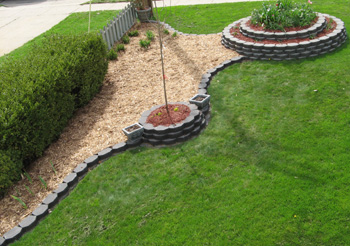 2 weekends ago it was amazing. We finally kicked the cold weather problem and had 2 days of beautiful, warm, dry, weather. I did a lot. I installed a new garden bed with around 150 large retaining wall bricks. I went through around 100 bags of dirt and 100 bags of mulch doing that and other things in my yard. In the picture the new part of the bed is everything that attaches the central raised island bed (which we did a few years ago) to the side fence.
I also installed two Fieldstone raised beds from Gardeners.com for my asparagus. I decided that after putting in so much work doing the nice brick bed, I’d save myself some time (if not money 🙁 ) and do a quick and easy plastic/faux-stone bed. I plan on writing a more elaborate review on the Fieldstone raised bed product at a later date.
However, what really happened is I got a horrible sunburn on the back of my neck. I guess it never occured to me to put on protection because I figured the sun wasn’t quite overhead enough being only April.
I immediately went on ebay and looked for a gardening hat. I have a large head, and I don’t think I look that great in a hat, plus I worry about being hot, but I decided I really needed to do something about it. Sunburns are bad, skin cancer is bad, looking dorky in a hat isn’t a big deal in comparison.
So, consider this post a reminder, protect yourself from the sun when you’re outside.
Ask a Question, Get an Answer
April 13th, 2007I’m not a master gardener, but I’d like to be one day, and of what I know, I think I know a great deal.
Anyways, in checking the statistics for this blog I noticed many people visit here looking for answers to specific questions, questions that may not have been answered already in the blog. If you’re one of these people, you can ask me a question and I’ll do my best to answer it.
Simply visit the forums and register. You’ll need to confirm your email address, that means you’ll get an email with an activation code or link that you’ll have to use. The activation email may get blocked by a spam filter, so be sure to look in your junk mail folder for it if you cannot find it, it should arrive in 5 minutes or less after you register. Once you have registered you can find the most appropriate subforum for your question, such as Landscape Design or Edible Gardening, and then look for the “New Thread” button to post your question.
If your question is about any plant I grow, I’ll probably know the answer. If your question is about a plant I don’t grow, I might know it, or I’ll try to find it. I know I won’t be able to answer every question, but I hope I can answer most.
Using Plants with Contrasting Foliage
April 11th, 2007I wrote a new article today on using plants with contrasting foliage. Check it out.
This is the first article in what will be a series. Now that I’ve laid the general groundwork I will go back and tackle specific plants for each popular foliage color such as red, blue, and yellow.