
Black Spot on My Roses
August 14th, 2007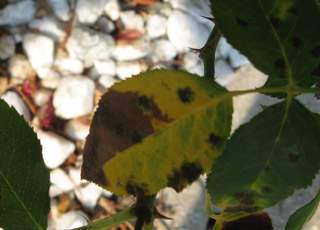 I’m no stranger to fungal infections on roses, it seems every year in late summer I get powdery mildew, it usually doesn’t cause too big a problem though and does hit all my roses.
This year, I’ve not been so lucky. I had a massive attack of black spot that affected almost every rose bush I had. I tried to take the high road and not use a product to combat it hoping the roses would be fine, but finally I had to take action. You see a few of my roses were at death’s door, I’m talking near total leaf drop and only a handful of (infected) leaves left.
I have some Daconil (topical fungicide) anyways, and I was trying to treat it with that, but it just wasn’t working.
So I went to the store and bought some Bayer Advanced All-in-One Rose & Flower Care which includes a systemic fungicide, in addition to some other stuff.
I bought it, I used it, the roses almost immediately (the next day) started looking chipper, and now, a week and a half later I’ve got new blossoms on plants that I thought were terminal. So consider this a glowing product recommendation.
Also, despite close proximity and infected bushes on all sides, two of my roses escaped the fungus, does this mean they’re immune? I don’t know, but it would seem they are atleast resistance to the strain of black spot I got. The first is “The McCartney Rose” which is a pink hybrid tea, the other is called “Eden” and is an old fashioned climber.
Now, for those reading this blog post, wondering how to prevent black spot and other fungal diseases, you’re supposed to practice the following techniques:
Never water the foliage, only the root zone.
Prune the plant to allow good air circulation.
Pick all all debris around the plant base.
I do 1 and 2, 3 not so much, but even if you do all of these things, it is said that if you grow hybrid roses, you will get fungal diseases, they’re just that susceptible. So don’t feel bad if it happens to you.
My New Tanyosho Pine
August 3rd, 2007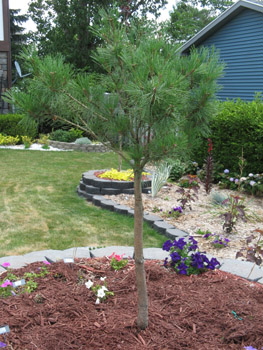 I went to Rome in June, read all about it here. I fell in love with the beautiful stone pines that dotted the landscape. They are a very graceful pine with no understory branches and an upside down pyramid flat-top upperstory. Unfortunately they are not hardy where I live in Michigan.
Well, a few weeks ago I went to Lowes and I saw this solitary pine sitting off all by itself in the middle of some potted annuals (not even in the tree section). It looked exactly like one of those Italian pines, except it was only 4 feet tall.
It was a Japanese Tanyosho Pine (Pinus densiflora “Umbraculifera†), a dwarf form of the Japanese Red Pine, it is also often called an umbrella pine or a tabletop pine. It is hardy to zone 3 (score for z5 me). It likes full sun, grows slowly to 15′ x 15′ and can be trained to be more of a bushy shrub with multiple trunks, or with 1 trunk (what I’m going to do). Apparently the bark eventually becomes a very interesting peeling red shade.
I got an excellent deal that day at Lowes, lots of things were on sale and I’m not sure if the tree was, but the cashier game me a 55% discount on it (so only paid $17), he also happened to give me a yellowish maiden grass for $3 instead of $15. I would have paid much more for this tree, I’m really glad I found it. It may be Japanese, but it’ll always remind me of Rome.
Deadhead your Daylilies to Make More Blooms
August 3rd, 2007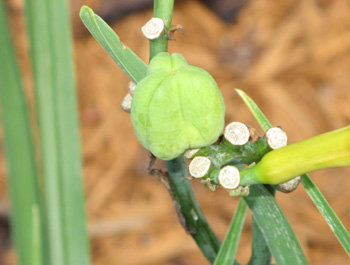 For me, July is prime daylily month, and July is now over. That means it is deadheading time.
Truth be told I deadhead constantly as I wander around the garden but this post is meant to remind others to do it, not myself.
You see, many popular daylily varieties, possibly ones in your garden right now, are rebloomers. If their scapes (those are the flower stalks) die back then they will send up new ones. However, if they do not die back, because of a seedpod for instance, no more flowers for you!
Additionally, you’re letting the plant put energy into seeds you probably do not want instead of working to get bigger.
So, when you see these hard little green pumpkins on your daylilies, pick them off. You may just get more blooms. Specifically for all the millions of gardeners who grow Stella de’Oro daylilies, if you don’t remove the seedpods you won’t get more blooms this year.
Now, if you truly wanted the seeds you could keep the pods on and harvest the seeds when the pods split open. However daylilies are hybrids, which means their seeds will not be identical to the parent, but rather an entirely new plant, a plant that might be better than the parent, but most often isn’t nearly as good. So most people don’t want to save their seeds.
Other uses for garden planters
August 3rd, 2007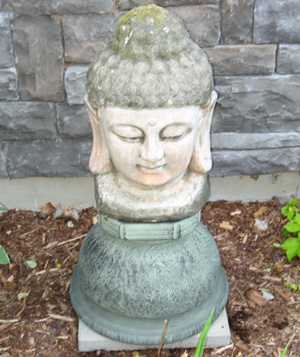 Containers are fun, I particularly like large ones, they add crucial structural elements to your garden, and allow you to microtarget a specific plant’s needs.
You don’t need to stop with plants though to find use for them. A container without a draining hole can make a small fountain with the addition of an inexpensive pump. Or, an upside down container can make a good pedestal for something else. Often what you’ll see people do is buy two identical containers and place one upside down and the other on top right side up so it makes a sort of hourglass shaped column.
So what prompts this post? Well I was at Lowes and saw this greenish hued pot, which very closely (compared to any other pot I’ve ever seen) matched this greenish asian head I had. The head was just sitting on the ground, which was alright but raising it would be better. So I bought the pot, and now it is a pedestal.
When I got home I realized they weren’t exactly the same color… but perhaps after the pot gets weathered some it will match better.
Sambucus nigra. “Black Lace” Elderberry
July 29th, 2007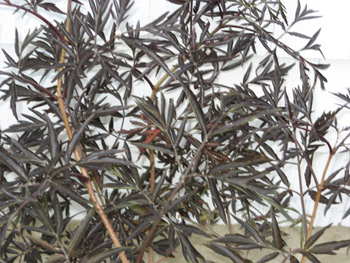 Sambucus nigra. “Black Lace” is a hot new elderberry cultivar that was available in very limited release in 2006. I first saw it in Wayside Garden’s fall catalogue last fall. When I went to order one it was already sold out.
I finally got on their waiting list late this Spring when they started offering them for sale again. But even then, I imagine I’d get a barely rooted cutting in a 3.5 inch pot or something. So imagine my joy when I went to Lowes today and saw 2 huge ones (the only ones they had, I bought them both). One was 4 feet tall, the other 3.5 feet, in large 2 gallon pots. I paid $19.95 each for them, which is a pretty good price considering the size.
So… whats all the fuss about? Well… this plant is just a great plant. It has lace like leaves, just like laceleaf Japanese maples. However, this is hardier a good one or two zones further North than such Japanese maples. Also… it gets great pink flowers on it in summer, big clusters, which really offset the black foliage. Oh yes… black foliage. Did I mention it is a true striking black? Finally there are berries, edible by humans and loved by birds (elderberry jams and wines are popular in certain locales). Oh, its very fast growing, takes pruning well, and grows in full sun or part shade. Eventually it should reach a mound 6′ x 6′ or more. I hear it can be trained into a tree form with a single standard trunk as well.
So ya, a true black leaved shrub is one thing… but this has beautiful lace leaves, berries, flowers, the whole deal. If you see one I suggest snatching it up quick, they are hard to find.
Consequently there is a related variety called Sutherland’s Gold which is bright yellow and would pair well with Black Lace for some good contrast.
Attract Yellow Goldfinches to your Garden
July 29th, 2007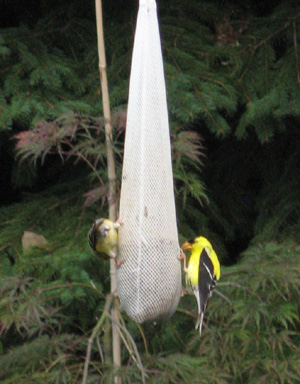 The American Goldfinch, Carduelis tristis, is a beautiful backyard songbird that happens to frequent our garden so I thought I’d share how I attract them with others.
The easiest way to attract these birds is with a sock full of niger thistle seeds. You can get these at most home improvement stores, but I’ve seen them for really cheap at Walmart. These mesh socks nicely contain the seed and allows the finches to eat at varying angles (such as upside down) that they’re oft to do at times.
There are also more expensive finch feeders, large plastic contraptions with multiple eating locations. These, I do not recommend. The socks accomplish the same thing, in a better way, for less money. We had one of these finch feeders before, and the birds would never use it, whereas they use the socks every day. So, apparently 9 in 10 goldfinches agree, simple socks are more useable.
These yellow birds love the seeds of thistles, dandelions, goldenrod, sunflowers (especially maximillian sunflowers, they’ve literally attacked mine for the seed), and coneflowers. They do not use cavities (houses) for nesting, prefering to nest in shrubs and trees, so a wooded lot of some sort is a good idea. And of course when trying to attract any sort of wildlife, water is a good idea as well. So a nice birdbath or fountain is recommended.
The American Gold Finch is a somewhat shy bird, they prefer to eat away from other species, so place don’t place your sock right next to any other type of birdfeeder.
My Favorite Daylilies
July 22nd, 2007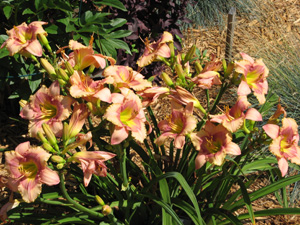 Daylilies are my favorite flowers. They are hardy, relatively disease resistant (depending on area), nearly carefree, and come in a wide variety of shapes, colors, and sizes.
There are though thousands and thousands of named varieties of daylilies, so to help you find some good ones here are my favorites:
FAVORITE OVERALL: All Fired Up
This is a great daylily with a very interesting main color and a red watermark and red edge. I find it hard to classify the main color though, it isn’t quite yellow, it isn’t quite orange, but it is something else entirely. This plant produces large, vibrant, flowers and can sometimes rebloom.
FAVORITE BIG REBLOOMER: Blue Ridge Shepherd Boy
I have probably over 100 daylily varieties, and not one comes closed to the bloom power of this one. I’ve pictured a full clump of it as the picture to this post. Small Apps daylilies such as Happy Returns bloom more, but they’re small diploid daylilies, this is a large tetraploid daylily with fancy substantial blooms.
FAVORITE SMALL REBLOOMER: Happy Returns
I’ve mentioned Happy Returns on this blog in the past, it is a cheap, common, tireless bloomer that makes an excellent border.
FAVORITE OVERALL REBLOOMER: When My Sweetheart Returns
This doesn’t bloom as much as Happy Returns, and isn’t as large or substantial as Blue Ridge Shepherd Boy (considering it is diploid) but the blooms are absolutely gorgeous. A soft yellowish cream with white ribs and a pink watermark. It is an expensive daylily to plant in mass or on a border, but if you can afford to get lots of it then you can make a great statement with a mass planting.
FAVORITE BLUE DAYLILY: Crystal Blue Persuasion
The color blue is not a color daylilies easily produce. Almost all daylilies sold as “blue” are really purple, lavender, and violet. Even when shown with blue pictures the picture is usually doctored to look blue. The only daylily I’ve ever seen that actually has any blue in it is Crystal Blue Persuasion, and even then it can depend on the lighting and individual plant characteristics. The flowers are small and cream colored with a grape watermark and a blue eyezone. It certain light that blue can look purple, but believe me, most of the time it is a nice blueberry blue.
If not for the blue this flower would be unnoticeable. It is small, and otherwise the blooms are unremarkable, but the blue is a unique characteristic.
FAVORITE RED DAYLILY: Anzac
Like a bold red tie, sometimes a bold red flower is needed in the garden. Anzac is just such a daylily. It has large, vibrant crimson blooms and is easily picked out from a distance. There are, I know, other, probably better large red daylilies out there, but Anzac is the best among the ones I own.
FAVORITE INTERESTING COLORING: Purple Maze
Like All Fired Up this one has an interesting color base, very close to peach but a little richer and more vibrant. What really makes it stand out though is the double watermark, first cranberry, then purple. This flower is a stunner. It also has a slight edge. The only reason this one isn’t my favorite is that it doesn’t bloom quite as freely as All Fired Up and the flowers sometimes take awhile to open fully.
Roses from Cuttings, or Roses from Grafts
July 15th, 2007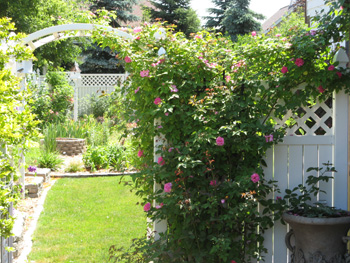 Most roses sold are hybrids, which means they will not grow true from seed. So to propagate such roses there are two main methods used, cuttings & grafts. Which is better? Well, let me tell you a story.
I have a ‘Zephirine Drouhin’ climbing rose planted near an arbor on the north side of my house. Being on the north side it doesn’t get much sun, and so the blooms have never been as abundant as I would like, but it has grown great. Canes grow that end up 15 feet long, new canes come up all the time, the thing is just grows like crazy. One problem I’ve had in the past though is it being eaten by rabbits in the winter so last winter I put a wire cage around it, so finally this year it was able to build on already existing growth instead of starting over. It also is high enough to catch sunlight at the top, over the roof of the garage, so finally the top of it atl east is getting sun. The end result is that finally this year it bloomed quite nicely.
Anyways, I planted this rose in 2003, it was a well rooted but only 6 inch high cutting.
I bought other of this same cultivar that were propagated with grafts, those have not even come close to the same vigor as this plant. Additionally, for us northern gardeners, a grafted rose can often be killed down below graft point, and when that happens any new growth will be based on the rootstock, and not the graft you bought originally. With a cutting it can die back all the way to the ground and the rootstock can still put up the same rose you bought.
So, in my experience, if you have the choice, buy cuttings and not grafts. Now, you’ll rarely have the choice, almost all commercial growers use grafts, but cuttings can be found at farmers markets, swap meets, from friends, on ebay, or otherwise from hobbyists.
A Border of Happy Returns Daylilies
June 29th, 2007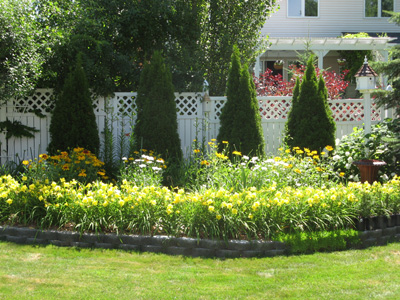
My back garden is looking great again this year and I attribute much of it to my row of “Happy Returns” daylilies. Remember, a daylily is so named because each bloom lasts only for 1 day, and yet each day this row is covered by atleast a hundred blooms, and such blooming power will last until October.
In my opinion there is no better plant with which to border a bed than a short reblooming daylily. All of the “Returns” daylies by Dr. Apps are this way. But there are others as well.
Daylilies excell as borders in my opinion for a variety of reasons. The ones I’m recommending are short, and so they do not block the view of taller plants behind them. They bloom abundantly, their grass-like foliage has a pleasant arcing form, and they’re very hardy. Once established hardly anything will tweak a daylily and hinder it’s bloom other than a lack of sunlight.
Some annuals might bloom more, but being annuals they’ll be more fragile, have higher water requirements, and need to be repurchased yearly. Not so with daylilies.
Buying enough daylilies to do an entire border might be expensive at a conventional store, but seek out a daylily farm online, you can often get bulk discounts, I only paid $2 for each of the 30ish happy returns that make up my border.
Also, to save even more money, only buy half as much as you need and divide them the next year. They’ll be small divisions sure, but they grow rapidly.
That is also one of the lasting benefits of daylilies, and other such perennials, eventually you will have extra divisions that you can plant elsewhere, sell, or give away.
I’m doing just that with my side back garden. I’m using one of the newest “Returns..” daylilies called “When my Sweetheart Returns” It is significantly more expensive than “Happy Returns” which is the second most common daylily and so is pretty cheap. At $10-$20 per plant I didn’t want to buy a lot of them, so I bought 1 (and actually when I bought it is was brand new so I think it may have been $24). I pampered it and took a 8 small divisions off of it last year when I had had it for 1 year, it produced 8 new fans in that 1 year. So now I have 9 small ones. Next year the border should start to look established.
Not all daylilies are good for this purpose though. You want small, normally diploid, rebloomers. In my opinion the common “Stella de Oro” daylilies are too big for this purpose, but they’ll do in a pinch. For the best results though stick to any of the daylilies with “Returns” in their name.
The Gardens of Rome
June 27th, 2007
I just got back from a week’s vacation in Rome. The ruins were nice, the art, it was all good, but I really liked the landscape.
All over the area we traveled around Rome (though not so much in Florence to the north) there were these massive pines I had never seen before. Turns out they’re Stone Pines (pinus pinea), sometimes called umbrella pines (though do not confuse them with the Japanese umbrella pine), and have been an important argicultural tree for thousands of years. Botanists think they were originally from the Iberian peninsula (Spain, Portugal), but since they were planted so widely along the Mediterranean so long ago they cannot be sure. These trees are the prime source of Italian (and other) pine nuts that feature so prominently in their cuisine.
Anyways, the trees are absolutely gorgeous. They have growth habit more like a broadleaf tree than a pine, with a clear understory, a nice branching pattern, and a large flat top canopy. So structural, shade casting but open underneath for under planting, and beautiful cracked orangish bark.
Alas… they appear to only be hardy to zone 7, maybe southern zone 6 with protection, and here I am in the middle of zone 5. Apparently there are some groves out in California that people have planted, but that doesn’t help me here in Michigan.
We do plan to move south one day though, so maybe at my next house I’ll be able to plant these beauties.
Overall I really liked the landscape of Rome, the rolling hills, the mix of trees. Now sure these pines are more adapted to warmth than cold, but yet they are still pines, and you’d find them planted along with (non-native I think) palms of varying types. Additionally very large (and also non-native) agaves could be found in many gardens.
Then nearly every building in Rome had a rooftop garden or balconies full of plants, that itself was gorgeous.
Unfortunately I didn’t make it to any formal gardens in Rome. We did go to the Vatican, but their garden’s were private by appointment only. Then for others they tended to be too far for easy transport (aka walking) and we were busy with all the other stuff. Yet I still got some pictures, to see the rest check out the gallery here.