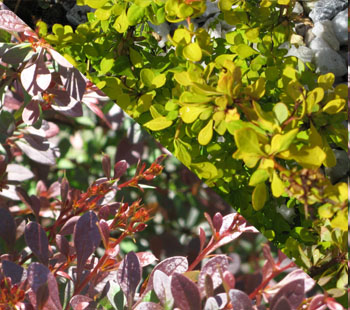
There is something to be said about barberries. They do not have beautiful flowers. Their scent can be bad. Their foliage, though nice, is beat by other plants. And yet I find myself thinking of them as one of the best bushes for the landscape.
The reasons? Sheer growability. Japanese Barberry (Berberis thunbergii) are hardy to zone 4, can take sun or shade, wet or dry, and will come back strong after a beating. We had one growing up along our foundation when we had new siding put on. Because of the thorns I needed to remove it so the workers could do their thing. I cut it down, and since I was too lazy to dig it up (it was quite mature) I just attacked it’s root ball with an axe and left it covered with debris. It was stepped on and worked on for months… and the plant came back and grew to 4 feet the next year. Any plant that can take that kind of abuse cannot be all bad.
Critters also will not eat barberry. It has been used as a herbal medicine and apparently it has a very bitter taste. I know it’s yellowish wood certainly does not look appetizing. So it is either from the taste, or the aforementioned spikes, but deer & rabbits leave it alone, and I mean that. I know in many gardening catalogues I’ll read “Deer tend to avoid.” and think its BS because I’ve seen deer eat that shrub before, but if anything is truly critter resistant, barberry is.
Most barberry you will find in nurseries and garden centers will be of the burgundy variety, and thats great. It is important to use contrasting colors in garden design and Barberries are a great reddish plant to use. However, there exists a newer variety that has yellow tinged foliage (pictured, along with a red variety). This variety is harder to find but with both a red and a yellow barberry you have all sorts of planting options available to you.
If there is one bad thing about barberries it is that they are deciduous, no winter interest except for a few small berries that the birds quickly eat. Though maybe further south some variety stay everygreen I hear.
So, they aren’t really standouts in any particular category, but they can be grown more or less by everyone, in almost any location, and can provide 2 nice non-green foliage colors to liven up your landscape. All that together makes them a great choice for your yard. My only word of advice would be to not plant them too close to paths or windows. Paths because of the thorns, and windows because their flowers are a little pungent (though you have to get really close to smell them).
June 11th, 2007 at 9:29 am
I just planted two red and one yellow barberry in front of my house. Western exposure gets H-O-T in the summer, but thought they could take it. The yellow has already lost a lot of its leaves and the reds are starting to wilt. Any suggestions?
June 11th, 2007 at 10:03 am
Water them.
I had the same problem with my newly planted golden ones (although, never with burgundy ones). The solution was just to water them.
Like all newly planted plants they need time to establish themselves and shortly after planting their roots are usually not at full efficiency.
Most of my barberries have a hot western exposure up against a grey brick house with stone mulch. All of which radiates heat. They’re all doing fine except for that initial leaf drop from the newly planted golden ones (they’ve since recovered).
Of course, it could also be a soil problem, since these are new plantings for all you know the soil could be bad/contaminated, or something of that nature. I’ve got this one spot up near my house that is about 2ft square and everything planted there dies, outside the radius its fine, but this one small spot in poison. I think someone must have spilt a chemical there at one point.
June 11th, 2007 at 11:24 am
But, and this is a big but, Japanese Barberry is officially listed as an invasive in 20 states, with more (like my state, MN) looking at adding it soon. Yes, they can take all sorts of adversity, but I’m not sure I would recommend planting it, especially anywhere east of the Mississippi.
See this link for more information: http://www.nps.gov/plants/alien/fact/beth1.htm.
June 11th, 2007 at 12:01 pm
Huh… I have never seen a barberry growing in the wild, only in gardens, and I’ve never had a seedling or other volunteer from my bushes around my house (in total I have around 20). Nor has any one plant expanded vegetatively to an invasive level (unlike something like japanese knotweed).
I wonder if the hybrids I, and most gardeners plant, are in fact sterile. It would make sense.
June 19th, 2007 at 7:25 am
They grow well over here in the UK aswell. Great for all the reasons you mention, but the lack of winter interest always puts me off.
Any ideas for something of a similar size with a bit more going on in winter?
August 13th, 2007 at 3:56 am
Any thoughts on the possibility of this particular species being perhaps invasive?
Having just posted an essay, I sure wish I had waited for your posting.
April 21st, 2008 at 5:50 am
Very invasive, please do not plant or recommend barberry.
Please research and blog on how to remove/conquer barberry.
Connecticut DEP is researching a way to burn the buds in Spring to kill it. ref Paul Capotosto, CT DEP, (860) 642-7239
April 21st, 2008 at 6:37 am
Again… I have dozens in my landscape and have never seen so much as a single seedling, anywhere, from any of them.
May 18th, 2008 at 1:04 pm
With the exception of the nasty job of having to remove fall leaves from the thorny branches of my barberry, I have nothing but joy from my hardy, faithful and beautiful barberry shrubs. I have both the rounded crumson pygmy and the more upright “spiny” variety. I have 50 plus shrubs, both individually and as hedge features throughout my 2-acre landscaped garden. Never have I ever encountered a “volunteer” seedling. They are truly the favorites of my garden.
May 27th, 2008 at 1:41 pm
The species selected by states for banning as invasive species is very bizarre. If “invasive” means spreading easily in the wild, then some really are, but others are not. For example, my state bans sale of Norway maples, but in 50+ years of looking at trees in woods, fields, etc., I’ve never seen them grow anywhere except in suburban neighborhoods.
September 25th, 2008 at 1:17 pm
Wow, invasive? Really? lol That’s news to me. Anyway, great article! I have 3 golden Barberries i’m planting in a new shrub garden I am starting this Fall. I love their golden shade, it should definitely contrast well with all the greens and reds. =)
April 21st, 2009 at 1:06 pm
If you have never seen barberry in the wild then your not looking. It is invasive and can displace native shrub species within the shrub layer.
April 21st, 2009 at 1:40 pm
Is it so hard to believe things are invasive or not depending on climate?
Every other house around here landscapes with it, and I walk through the wetland preserve behind our house almost daily, I’ve never seen it growing there.
I grew up living in the woods, my parent’s mailbox is a mile from their house. Never saw barberry there either.
May 9th, 2009 at 2:02 pm
I think these bushes are great! I have never seen any problems with invasion in East Texas, and just bought a new one for my garden as well!
May 10th, 2009 at 7:51 pm
Barberry is invasive under the right conditions. I have a woods loaded with it and I have spent the past 12 years trying to clear it. Look into native species to plant for your yard and PASS on barberry.
May 19th, 2009 at 8:22 pm
Does anyone know about the companion planting properties of Barberry? Does it fix nitrogen or other atmospheric nutrients in the soil?
I have 7 in a property I inherited – never seen them spread or invade other spaces.
June 3rd, 2009 at 7:10 pm
Will barberry grow healthy at a home that is located on the bay and will on occasion get sprayed with salt water?
July 17th, 2009 at 7:39 am
many leaves on my 2 year old barberry are turning brown, I think it gets plenty of water and not burning sun…….Does anyone know what kind of soil it likes, ie: acid or base? thanks Any help would be appreciated
Also, it is not invasive in Oregon
July 30th, 2009 at 3:54 am
Our Conservation Commission is currently battling barberry in a town park. It spread from an abandonded farm and now covers 10 acres. It is almost impossible to walk through and has displaced all native speciesin the forest It will take us years to remove it by hand.
September 10th, 2009 at 5:45 pm
There was a barberry eradication program in the US for a long time. It is a host for stem rust of wheat and other small grains. Not all species of barberry are hosts, but the proliferation of barberry is a concern. The potential for crop loss to stem rust is very high.
September 19th, 2009 at 11:39 am
I don’t see anyone mention where they live; that makes a big difference in whether a plant is invasive or not. Plants that only grow when watered in drier climates, may become invasive in wetter areas.
September 29th, 2009 at 11:35 am
We live in Northern New Jersey. Barberry grow wild throughout the area. The fact that it is virtually deer resistant makes it the only shrub that now grows in the woods next to our home. The forest floor was bare until the barberry took over. it may be invasive but so are the deer and at this point I will take the barberry.
October 22nd, 2009 at 5:42 am
I do woodland landscape restoration and see this dreaded plant in the woods all the time, with nothing else growing around it. Barberry is listed as an invasive because of its allelopathic properties and activities and is destroying the diverse habitats of fragile woodland gardens and protected lands. Birds eat the seeds found in peoples backyards, then disperse them. Brooklyn Botanical Garden offers a few alternatives to Barberry in their book titled “Native Alternatives to Invasive Plants”: Witch Alder, New Jersey Tea, Virginia Sweetspire, Bush Honeysuckle. PleaseBefore planting, please do the research first to determine whether a plant in question is invasive. Go to http://plants.usda.gov/java/noxiousDriver
October 22nd, 2009 at 6:02 am
Invasiveness is always going to depend on climate.
January 3rd, 2010 at 8:37 pm
I’m planting them because of skanks that use our fence to hop over and steal bikes in the neighborhood–along with nettles underneath.
May 12th, 2010 at 9:40 am
Dead barberry thorns can harbor an organism that when pricked by the thorns can be very dangerous. I have a friend,wearing gloves, who was pricked through the gloves. She has blood poisoning from the prick and had to undergo chemotherapy.
September 27th, 2010 at 4:38 pm
I planted barberry shrubs for the first time this summer. The leaves are turning brown and have spots on them. Is this normal and do they lose their leaves in the winter. Thanks for your help. Barb L.
October 16th, 2010 at 9:57 pm
Japanese Barberry is an invasive species in Connecticut according to CT Department of Environmental Protection. Hundreds of thousands of dollars are spent each year in the northwest corner of Connecticut alone on eradication. Birds redistribute seeds in their excrement spreading the plant the plant. Mice, which nest under the plant’s thorny protection harbor a huge number of disease bearing ticks. This plant is a pestilence here in western Connecticut. What unwise advice to actually plant the stuff. Please do more research and rethink your position.
October 17th, 2010 at 5:27 am
Fun fact: Not every blog on the Internet is about Connecticut. Some of us DO live elsewhere.
April 30th, 2011 at 3:13 pm
Here in Connecticut all barberry plants are considered invasive. The former owner of our house planted them around the edge of the yard. Although I initially thought them pretty, after living here for 6 years, I have grown to strongly dislike this plant. It has taken over much of the landscaping, crowding out beautiful native plants, a wonderful red and black raspberry patch as well as growing into the lawn. It is amazingly resistant to destruction and spreads like wildfire! The only way to kill it is to cut it down and spray a 75% Round Up mixture directly into the stump. It is being banned from nurseries in Connecticut and other states too. Stay away from this stuff!!
June 6th, 2011 at 1:40 pm
My neighbor cut down 3 of these bushes about 9 yrs ago along the fence line. Instead of bushes, it came back as some creeping thorny weed from hell. It has taken over half of my yard and is killing the lawn grass and my mower. Can I kill this with Ammonium Sulfamate?
June 20th, 2011 at 9:16 am
My husband and his mother are highly allergic to the barberry. Although I really like how they look, we have decided to remove them simply because my husband can’t be near them at all.
July 26th, 2011 at 10:49 am
No one has seemed to realize that the berries are edible! Sure they’re very sour, but in Persian cooking or in a pilaf they add a wonderful tartness. Perhaps harvesting the berries will take the sting out of their presence.
September 15th, 2011 at 8:34 pm
Barberry is a tough, difficult invasive that has spread like wildfire in Pennsylvania, crowding out everything else. It grows so thickly that nothing else can compete, and it gets so tough that you cannot walk through it.
Do not plant it! You are insane if you do! It is a major pest.
September 17th, 2011 at 8:23 am
I planted 2 red barberry bushes that were red when I bought them, but they have lost all of their color. Any suggestions?
September 17th, 2011 at 4:15 pm
The color comes out most in sun. If it is shady it’ll be more green.
September 21st, 2011 at 7:47 pm
I just bought a rose glow barberry that I will plant in the next few days. I live in a desert. No worries of the thing surviving outside of my flower bed. I read that you can create new shrubs by rooting a piece of the stem you prune off? It is a beautiful bush with lovely coloring!
October 18th, 2011 at 1:49 pm
Does the Barberry have to be covered in the winter? I planted one earlier this year in my landscaping in WI and have no idea if I should cover it for the winter. I live in Zone 4 for hardiness…it didn’t say how to winterize it on the tag on the bush itself when I purchased it. Thanks!
October 24th, 2011 at 10:33 pm
I just helped with an invasive species clean up this past weekend near one of the dunes of west Michigan and barberry is all over the place. It is becoming a big problem around here too and I wish gardeners would do more reading before they just plant.
November 1st, 2011 at 10:29 am
I landscape for a living. I plant and trim Barberry many times every year. I can’t believe we are all talking about the same plant except that I know climate is an issue for all plants. I love Barberry because, very hardy, lots of colors, easy to keep a desired shape, easy to trim. If you pick up Barberry trimmings without good leather gloves, you won’t do it agaain.
January 14th, 2012 at 3:47 pm
I live in Salem OR and am wanting something to plant along my north facing fenceline. s there a particular variety of Barberry you wold recommend?
April 21st, 2012 at 12:45 pm
I my position as an environmental scientist I spend many hours in urban and suburban forests doing environmental assessments on forests in Maryland. I find barberry all over the woods, crowding out native shrubs and tree sapling….. generally causing havoc on the regenerative potential of the Mid-Atlantic forest. This is NOT a plant for your landscape. It is so hardy that it will overtake everything. There are lots of native and non-native non-invasives that should be substituted. One quick google search for ‘alternatives to barberry’ should produce a good list.
July 7th, 2012 at 4:14 am
The property I live on has 60 acres of land and I’ve never seen a wild barberry bush spring up. For that matter I’ve only seen 3 burning bush shurbs pop up in our yard a few feet away from where we had planted them (15 years ago). Easily taken care of by digging it up (probably would been a $ 75 shrub at a nusrery). Both are banned in MA. I’ve not discovered them in the wild either.
Before banning a plant the state should do a study on ALL varieties of a plant to determine if a certain variety is sterile. I’m not convinced all barberry plants are “bad”.
I can’t stand when save the planet types say they can’t get rid of an “invasive”plant. Breakout a pair of heavy duty loppers and cut it down to the stump. Use a motorized weed wacker with a cutting blade. Either dig out the root ball or hit it with Roundup. How about burning them?
How is barberry any worse than wild thorn bushes that seem to spring up everywhere and take over?
The only invasive plant I’ve seen that is truly awful is purple loosestrife.
Save the earth types need to chill out. Greenies will be horiffied because I suggest using a weed wacker…too noisy and dirty (might disturb the birds) or burn them (too much air pollution)…or Roundup (I’m poisioning the planet). Do you have any better suggetions?
Don’t forget Mother Nature is much stronger than enviro wackos give her credit for! The EPA and over zealous “conservationalists” are killing our country! Stay out of my backyard!!!!!!!!
August 9th, 2012 at 12:28 pm
Perhaps “invasive” is the wave of the future of this planet. Instead of type casting it as invasive, spin it and think “sturdy and resilent”; isn’t that saying that it is a healthy survivor of the times. Isn’t life about survival of the fittest, and moving on.
My store sells the shrub. I bought and planted the shrub. I like the shrub. Get over it.
September 30th, 2012 at 11:35 pm
I have one with lime green and white mottled leaves and one with old growth that is burgundy and new growth that has burgundy, pink and white mottled leaves. They are lovely.