
Golden Yellow Ground Cover for Shade
February 26th, 2008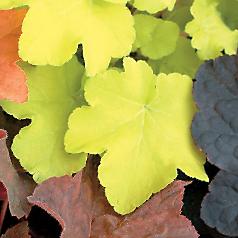 I have a beautiful laceleaf japanese maple with crimson foliage in a shady corner of my yard, and by shady I mean, really shady. It is in a corner between my shed and a large spruce, so that it literally gets 0 sun, except maybe around the Summer Equinox it might get a little. Anyways, despite having hundreds of pictures of my garden, apparently I lack even a single one of this nook that is in focus. So, I couldn’t include a picture of it for this post. (I included one of my options for planting there instead, read below).
Anyways, I’m a big fan of using contrasting foliage colors when laying out my gardens, and so I’ve always wanted a yellow or golden ground cover (or other short plant) to go underneath the tree. The yellow ground cover would contrast with the red leaves, making them see all the more redder (making them “pop” if you will) and vice versa.
One problem with variegated or oddly-colored (not green) plants though is that their coloring can be affected by sun exposure. Some plants are green in the shade and only get their color in the sun, others have color in the shade but “green out” when exposed to sunlight.
Currently I have a few heucherella ‘Sunspot’ but it would appear this heucherella needs a little sun to get it’s full color, as it is a drab green for me in that deep shade.
I have thought about getting a hosta, but.. in addition to contrasting foliage colors I also like to do shapes and sizes and I already have some hostas ringing that bed. Still, Hosta “Little Sunspot” looks good, and I know hostas will show their interesting color in deep shade (sun greens them out), but I’m not 100% sure about it. If anyone knows a small narrow-leaved golden yellow hosta, please comment. All the hostas around the bed currently have normal heart-shaped leaves, so a narrow-leaved one would still contrast and look good.
If it were a sunny location I would just use ‘Creeping Jenny’ aka moneywort aka Lysimachia nummularia ‘Aurea’. This is a vibrant yellow, fast growing (almost invasive) easy to replicate, cheap, ground cover. Alas, it needs sun to achieve the right banana yellow hue I am after.
In my scan of gardening catalogies I saw a plant I’ve no experience with. Veronica ‘Golden Halo’ (picture) looks great, and apparently grows in shade, but I’m unsure if it will achieve that color in shade or if it needs a little sun. I also saw some pictures of a Veronica ‘Sunshine’ (picture), but some of the pictures look awfully green so I don’t trust it.
Right now I’m leaning towards Heuchera ‘Citronelle’, it is the image pictured above at the top of this post. In my experience, heucheras receive their best color when in shade, and sunlight greens them, so, I would hope that this would be as yellow as it can be in the shade. However, heucherellas are closely related to heucheras and my experience with the heucherellas there hasn’t been good.
So, before I pull the trigger and order some of these, I’m hoping I’ll get some feedback from others. So please comment if you’ve grown any of the plants I’ve mentioned, or have ideas for ones I’ve not yet mentioned. Remember, it has to have yellow foliage, that will stay yellow in full absolute shade. Also, the spot is moist, and I am in zone 5.
New Wayside Gardens Coupon Bonus Code
February 26th, 2008This one is pretty good. $15 off $75. IF you spent $75 on the dot that makes it 20% off. I buy a lot of stuff from Wayside, they tend to provide good plants of good size, nice selection too. They’ve also made good for me repeatedly when a plant came dead or died shortly after coming. Anyways, looks like this offer expires 3/31/08.

AeroGarden Review
February 21st, 2008My wife got me an AeroGarden for Christmas. I had seen these before, and even was offered a gig consulting for the company with their Internet marketing, but overall held off because of our cats, and their penchant for eating anything I try to grow indoors.
My wife though was, apparently, willing to sacrifice for me a spot in our dining room the cats cannot reach and so she bought me one, with the included herb packet.
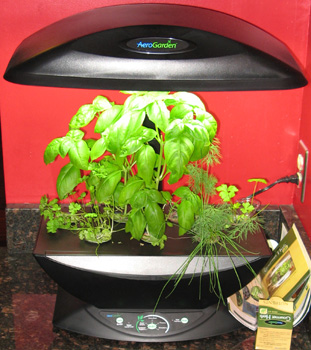
Other than gardening, my second most active hobby is cooking, and I do like using fresh herbs when I can, so this makes the product attractive to me. I get fresh herbs in winter. Anyone who has ever bought fresh herbs at the grocery store knows how expensive they can be.
Setup was fairly easy, and as an experienced gardener, altogether unconfusing. However a gardening newbie might not fully understand how aeroponics works and not find it all as intuitive as I did.
I received my first disappointment shortly after setting it up though. I always assumed you could grow anything you have seeds for with this system, but they instead seem to just use proprietary little seed pods, which aren’t of course as cheap as seeds from other sources. A little bit of a razor blade business model maybe?
So I had the herbal seed packet, which included two types of basil, parsley, mint, dill, chives, and cilantro. I set the machine up and started it going and waited. After two weeks everything was growing except the cilantro, after 3 weeks still, no cilantro. So I was quite happy because I think cilantro is nasty. I tucked some flat leaf parsley seeds I had in the cilantro pod and they are now growing. This makes me hope that maybe I will figure out a way to reuse the pods (the problem is, they will be full of the roots from the previous growth).
Since that time the basil has grown really well, but the other plants notsomuch, partially because the basil may be crowding them out. It wasn’t my choice though, there was an actual diagram included with the seeds to prevent crowding, apparently though, it just doesn’t work.
I’ve already used and harvested the basil a few times, but I don’t know when, if ever, I’ll harvest the others. They just haven’t grown enough yet.
The grow lights I find a little disconcerting. They appear to be normal fluorescent grow lights, and yet they give off way more heat than normal fluorescent grow lights I’ve seen before. Additionally they do not lock into their sockets, at all, and so every once in awhile I have to push them back into the sockets they have come loose from.
I also have run into the problem that happens to all who grow indoors, weak stems and drooping plants. Any gardener will tell you that plants develop strong stems in response to wind and other disturbances like rain. Plants grown indoors do not have this and so often end up weak and unable to support their own weight. I read a review where someone had setup a fan across from her AeroGarden on a timer to simulate a daily breeze, quite frankly I don’t want to go to so much effort.
Overally I have a mediocre opinion of this product. Okay, for herbs and maybe salad greens, it could be useful. But I don’t see it really being able to grow good veggies like peppers as the marketing material says it could, I don’t see the stems being able to support the weight. Additionally I dislike that you’re dependent on them for seed pods, and the light socket seems poorly made.
I don’t mind having it certainly, but I’m unsure if I would have ever bought it for myself.
Park Seed 10% Off Coupon
February 8th, 2008This is a really good coupon, I don’t think I’ve ever seen them offer such a nice coupon before. Especially if you’re like me with the potential for placing a really big order. Normally their coupons are like just $5 off, or a free plant (that I’m sure they’re way overstocked in) this though, 10% off is quite nice. I believe it runs through the end of this month.

Something to Grow: Black Currants
January 14th, 2008I was just reading an article about black currants and my interest was piqued. I am really into nutrition and apparently black currants have twice the antioxidants of blueberries, double the vitamin C of oranges, and double the potassium of bananas, among other health virtues.
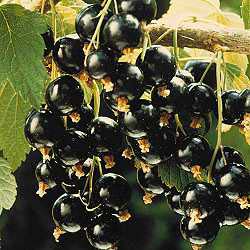 But you cannot buy them in the store, even if you think you can. The currants most stores have listed, and indeed the currants most recipes call for, are a type of dried small Italian grape (so-called “zante currants”). The reason you cannot buy them is that they were illegal to grow for many many years in the US (big business in Europe though). Apparently it was thought that they acted as a surrogate for a disease that affected the white pine lumber industry and so to protect that industry they were banned. They are only now just recently making it back. So, if you can’t buy them, what choice do you have but to grow them?
They are also apparently very productive, producing a large amount of fruit per acre (or bush, I’m sure none of us are going to grow acres) , which means you get more value, in real dollar terms, from growing them than growing other things.
Though apparently they don’t taste good raw, you need to cook them and sweeten them first. I do hear however that they make really good jams and jellies, as well as sauces for meat, or even wine.
They’re hardy in zones 4-7, making them excellent for most of the continental US, especially places where you cannot grow citrus (the other way to get large amounts of vitamin C).
I think I might just get a bush. I’ve searched online and the only place I can find them presently is Gurney’s, and they’re sold out right now.
Gardening Catalogue Deluge; What to Plant?
January 6th, 2008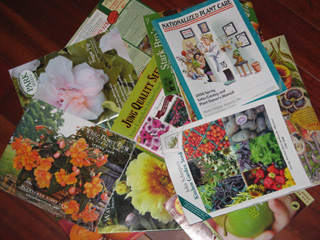 Apparently all the nurseries have a conspiracy to bury us gardeners in catalogues starting the week after Christmas. I don’t get why, but apparently we all must start thinking about what we want to plant as soon as we’re done taking down our Christmas tree. In the past week and a half I have gotten probably on average 2 catalogues per day.
Though true, I am thinking about what I am going to plant this next year.
I do not have a lot of remaining room to plant anything, last year I made a whole new bed and so gained probably another 500 sq/ft of space for planting and got to buy a whole bunch of new plants, but I don’t have any more room for any more new beds and so I don’t think that’ll be happening again this year. Well, okay, there is one spot I might be able to put a bed if my wife let me, but I think I’d wait until 2009 to do that just to give her a little time to recover.
So I have to be very very selective with what I buy, I only have a few spots left. One thing I know I’m going to buy is another ‘Caramel’ heuchera from Wayside Gardens. I bought 16 last year to make a little hedge border and they look nice. But one that got more sun than the others died (these were marketed as sun loving heucheras, obviously they’re not, but since I do have 15 of them now and need to fill a gap I will buy one again despite the mismarketing). I also like their new ‘Tiramisu’ heuchera which I may get to plant underneath a red japanese maple, hoping the golden/yellow leaves will offset the japanese maple and make it pop. Currently I’ve got some heucherellas underneath it but they’re not as yellow as I’d like, more lime-green.
I also saw this picture of ‘Beni-kazi’ Japanese forest grass in a magazine and I find it very attractive. I do not know if I have a good spot for it yet, but I plan to think hard about it. The coloring is just so nicely unique. I would like to hear from anyone who grows it, please comment if you do.
Mostly though, I’m thinking about planting edibles.
We eat a lot of blueberries for health reasons, to the point where I buy pounds of frozen ones at a time. I’ve tried growing them in the past, but they’ve been hard for me. I think I over-acidified my soil in preparation and they didn’t grow well. Then the second winter the rabbits got them. Since the rabbits didn’t eat them the first winter I didn’t protect them the second winter. But, we do eat so much blueberries, I think I will try again. I have to dig up the bed anyways because one of my brick walls around it settled and is now uneven.
Really though, the one plant I am looking forward to growing, and the one plant I recommend all of you grow, is sweet corn. Now, hear me out. No, you don’t need a lot of space to grow corn. I am not asking you to grow a field of corn, I am asking you to grow one or two stalks, whatever you have room for. As I say in this post veggies can be ornamentals too and there is no reason why you can’t put 1 stalk of corn in a flower bed as a bit of vertical interest.
However, when I choose which vegetables to grow I have two main criteria. What will be cost effective to grow, ie which foods are expensive to buy, and which foods offer a nice improvement over store bought when you grow your own. See, food sold in stores is often grown for disease resistance, or shipability, but not flavor. So food you grow at home can very easy taste better, it isn’t just psychological either.
Corn, happens to fit both those bills. If you’ve never had fresh picked sweet corn you don’t know what you’re missing. Corn starts converting sugar to starch the second it is picked. Some foods ripen after picking, some foods however never are as sweet as they can be unless you grow them yourself, let them ripen on the plant until just perfect, and then eat immediately. Apricots are a good example with bland grocery store ones paling compared to home grown ones that are allowed to ripen on the tree, and corn is the same way. Some corn fanatics in fact will start the water boiling before picking the corn, seriously.
Corn is also becoming more and more expensive thanks to (perhaps misguided) the corn ethanol craze. Making ethanol from corn is a really inefficient use of resources, corn requires water, fertilizer, lots of labor and equipment, and you only get a net gain of something like 30% (energy in, energy out). Switchgrass ethanol, in comparison, grows without much water or fertilizer and gives a net gain of something like 800%. But the corn lobby has convinced the goverment to subsidize corn ethanol, which increases prices for almost all food, other veggies because less of them are being planted in favor of corn, most meats because corn is fed to cattle and as the fed price increases, so does the cost of raising cattle, and, most of all, corn itself. As the value of ethanol corn increases, sweet corn becomes marginalized and more expensive. So while it has traditionally been seen as cheap, this next year corn is expected to be ridiculously expensive.
So, I will be planting corn this year, maybe as much as 4 stalks, afterall I do not have much room. I recommend you do the same. You’ll get yourself a treat with the best corn you’ve ever tasted, and you’ll save some money at the grocery store.
Brewing Compost Tea on the Cheap
November 1st, 2007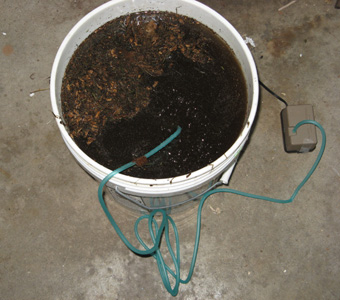 “Wow, a picture of a bucket in a garage, nice blog you run Chris.”
In all seriousness, this is my compost tea brewing system. It isn’t pretty, but it only cost me about $15, $5 if you discount things I already had.
Compost tea is a great product. What it is is compost seeped in water and oxygenated. Two things happen, the nutrients are extracted and the microbes multiply. Compost Tea can then be used as a fertilizer, soil conditioner, foliar feeder, and disease or pest repellent.
You pour it directly on plant leaves to feed them, this works the same way as Miracle Grow, the plants will absorb the fertilizer through the leaves quickly and so respond quickly.
Also, the microbes within the tea are good microbes, by placing them on the leaves you leave less space for bad microbes, resulting is better disease protection. I’ve heard that it is especially useful against powdery mildew.
If you pour it on soil the nutrients will still work, just slower through the plant’s roots, and the microbes will help condition the soil. Remember healthy soil is living soil and if your soil is dead from too much synthetic fertilizer, chemical spills, salt, or whatever, getting the beneficial microbes reestablished will help any plants planted in the area.
You cannot burn plants with compost tea, so don’t worry about applying it too thickly or too often. Twice a year is alright, but a couple times a month if you have the energy would be great.
So, how do you make compost tea? Well, you can buy really expensive brewing machines that produce large amounts of compost tea. You can also buy little 1 time use tea bags to soak in water. But there is a cheaper way.
Get 1 5 gallon bucket, you probably already own one, just make sure it wasn’t used to store any chemicals. Get 1 aquarium pump, you also may already have 1 of these, if not, any store that sells fish will have one. Get some aquarium pump tubing, and a air stone diffuser (thing that makes bubbles at the end of the tube). Then get compost from your bin, tumbler, or pile.
Put the compost in the bucket (or, for easier cleanup, put the compost in some old nylons, tie off the end, and then put it in the bucket), fill the bucket with water, put the stone (attached to the air hose) into the bucket. Let it run for 24 hours, in the sun if you can, or in your garage. You have compost tea. Strain it with an old strainer, toss the solids in the garden, and use a watering can to feed the plants.
This same concept can be used on a larger scale with a rain barrel and larger scale pumps such as those for ponds or larger aquariums.
You can also use something like a paint filtering bag, nylons, or other such things to put the compost in so you do not have to strain it afterwards.
I’m brewing some tonight for a fall feeding, I’ll focus mostly on my roses and a few plants that are less than healthy. Then some spots in my lawn that I think might be having some fungal problems.
Now there are products out there, additives and activators and things to add into the compost tea. I don’t buy them as a concept. The point with using compost tea is to use something natural that you can make yourself, even if the additives you buy are all natural, they’re still manufactured, shipped all over the country, packaged, etc. You might as well buy Miracle Grow if you’re going to buy all that stuff. Keep the compost tea simple: Compost, water, oxygen.
Two tips: 1, if you have city water put the air hose in the bucket for around 10 minutes before adding compost to try to get rid of some of the chlorine. 2, if you compost tea smells bad, it is bad, start fresh and try again.
Hardy Perennial Hibiscus
October 10th, 2007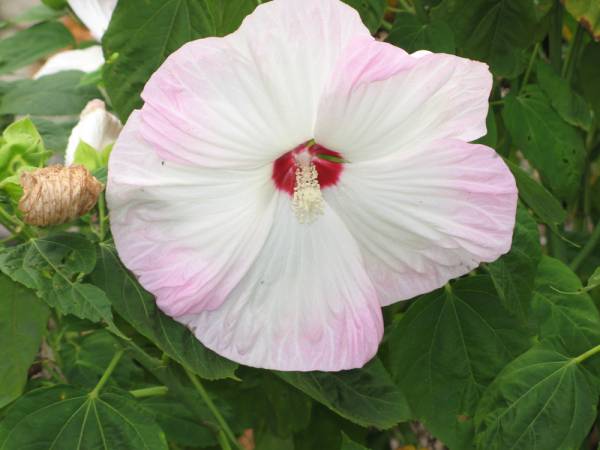
The flower form of hibiscus is very common to the tropics, blooms typically 4-6 inches across that are brightly colored and form on shrubs. Many people in more northernly climes also grow them as patio plants.
But did you know you could plant hibiscus plants with flowers twice the size in the ground in your garden and they’d be hardy? You can.
The plant you’re after is Hibiscus moscheutos sold as Rose Mallow, Swamp Mallow, Hardy Hibiscus, or Perennial Hibiscus. This large perrennial can be hardy as far north as zone 4, and will produce absolutely huge 10-12 inch blooms in shades of white, red, and plum.
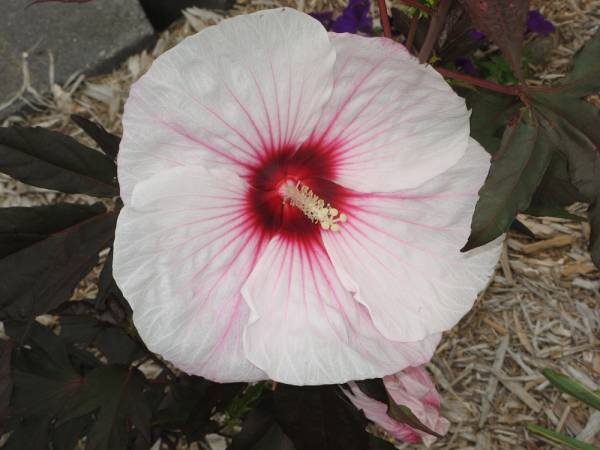
The draw of this plant doesn’t stop there though, a quasi-recent new variety called Kopper King features burgundy & green foliage with deep cut leaf margins, making it an excellent plant even when not in bloom.
Even nicer, the newest Pinot varieties (Pinot Noir having red blossoms, Pinot Grigio having white blossoms), have mottled purple and green foliage with a very interesting crinkled texture.
These plants require full sun and a good deal of water. They’re late starters, often not emerging until late May where I live, but they grow rapidly to 3 feet. The best solution for zone 4 or 5 gardeners is it cut them back after the first killing frost in Fall and then cover them when cold weather hits with a styrofoam rose cone thing. That should give them just the little bit of protection they need in order to survive and or start a little earlier than late May.
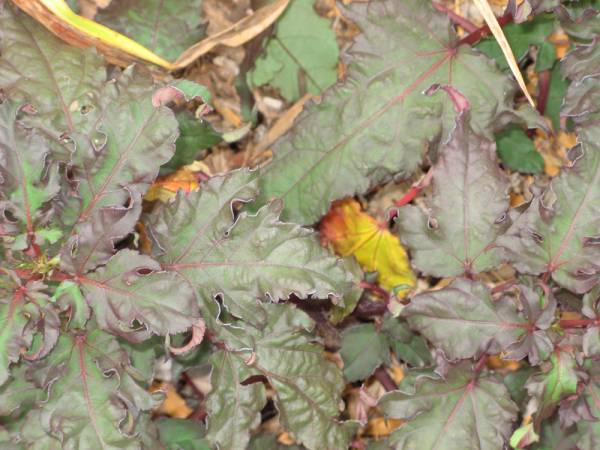
I’ve not noticed any disease problems with mine, with plenty of water they do just fine. However Japanese beetles do like their foliage so be vigilant and either put out traps or manually kill the little buggers in the evenings where they are out and about.
All told, this plant is one of my favorite plants. It is relatively carefree, gives you striking foliage, and striking blossoms. Plus, it is somewhat unusual from your standard suburban garden fare.
Edible Ornamentals
September 12th, 2007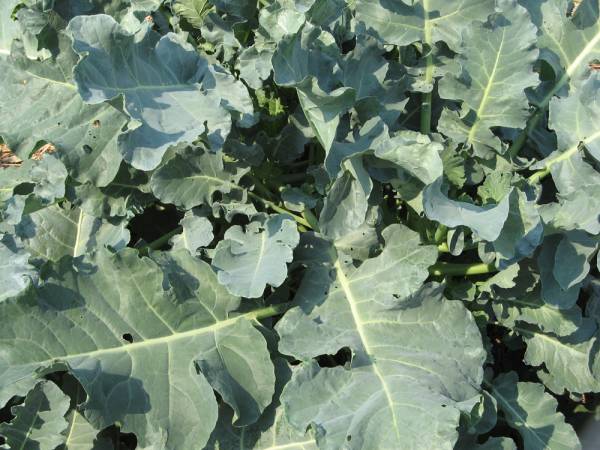 When planning your garden design do not forget that you can use vegetables in your ornamental beds.
Yes, I said it, vegetables in your ornamental beds. For some reason people see an ornamental bed as featuring eye-pleasing designs with organic layouts and nice flowers. Whereas a vegetable garden needs to have straight orderly rows like a farm.
Break out of that mold, some of the prettiest plants you’ll find are vegetables.
For instance, can anyone name an annual (or perrenial) for that matter that will grow to around 30 inches x 30 inches with wonderful blue-green foliage most closely matching a Colorado Blue Spruce that will also flower with nice light yellow blossoms? There are almost 0 perennials or annuals that produce blue foliage which can be a problem if you’re trying to use contrasting foliage colors. But you know what? Broccoli fits the bill nicely, and if you do not harvest the heads you can watch them mature into pretty yellow flower clusters.
 So, plant some broccoli, it doesn’t have to be a whole row. 1 plant in the middle of your flowers can make a statement with it’s striking foliage. You might even get some food out of it.
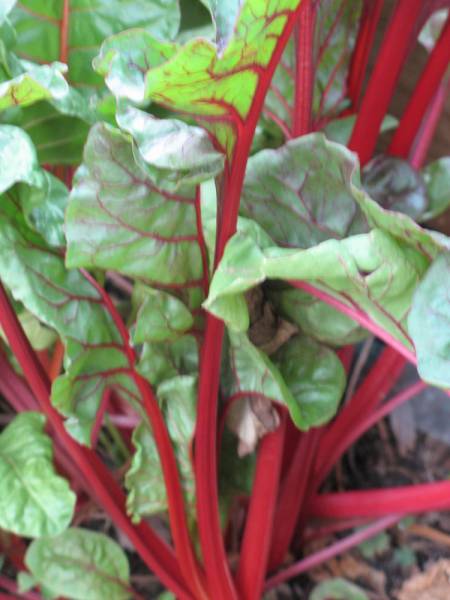
Then what about swiss chard? Have you ever seen a plant that produces foliage as red as the stems and leaf veins from swiss chard? It is as vibrant a crimson as I have ever seen in the plant world. It makes a great foliage plant when placed among other plants, particularly those with yellow foliage.
Corn can provide a nice vertical statement, asparagus delicate fern-like foliage, pepper plants look gorgeous with their brightly colored fruits. There is a whole world of possibilities for attractive edibles out there, try planting one or two within your flower beds. They don’t need to be in orderly rows.
Butterfly Bush
August 27th, 2007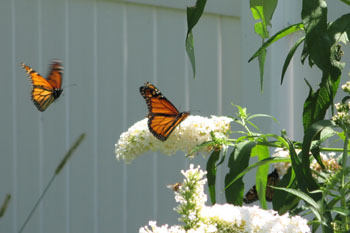 I’ve blogged about butterfly bushes, or Buddleia, before, but I felt the need to do so again today.
You see, I went outside and noticed no less than 10 large monarch butterflies on one of my bushes. I tried my best to get a picture of them all but it wasn’t working well, the best one I got in the one here with the post. When I got close and the butterflies got spooked and took off I felt like I was in a butterfly sanctuary they were all over.
Butterfly bushes are apparently sometimes invasive in warming climates, but in cooler areas they do not take over like that. So what you have is a decent looking large bush that grows quickly to 7 feet or more (though it will die back to the ground each year in zone 5 where I live), that attracts butterflies like moths to a flame.
They’re also pretty cheap, usually for less than $10 at a garden center and you can buy them during the fall clearance sometimes for even less. The one pictured I paid $2.50 for.
If you want to attract butterflies to your garden I know of no other plant that works so well, give it a try. There is also a new dwarf variety that you can find at places like Wayside if you don’t have room for the big ones. Finally I’ve also seen a silver leafed variety that gives some foliage interested as well as the flowers and butterflies.