
Water Garden in Spring
May 2nd, 2009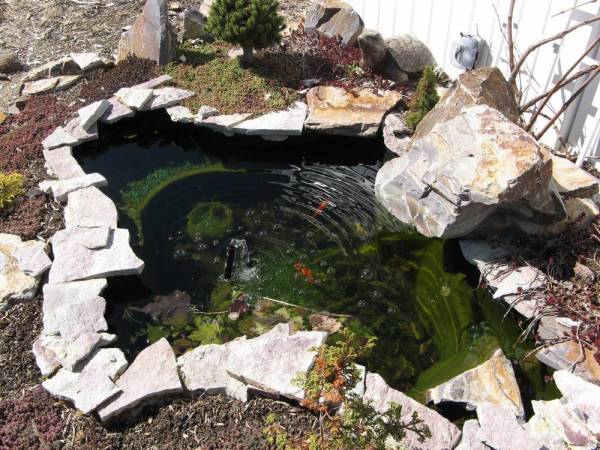
Last spring I built a water garden, I had wanted one for years but was seriously intimidated by it. Turns out it was far easier than I thought it would be, and I completed it in a weekend by myself in all aspects except having a new outdoor outlet installed in the middle of my garden by an electrician.
You can read more about my water garden here and learn how to build one yourself with my article, How to Build a Raised Stone Water Feature Pond.
I thought I would give an update on the pond. It faired well through the winter. I kept the pump running just with the fancy fountain tip removed so that the constant water flow largely kept ice from fully freezing over the top which is important for gas exchange to keep the fish alive. Science tells us that so long as water is liquid, it cannot (salinity aside) get below 32 degrees. So you don’t need to heat the water, so long as you keep it liquid, and the fish will live. But as well there needs to be a way for water to release and get gasses from the air, so keeping a pump going is a doubly good idea. And yes, as you can see in the picture, the 5 goldfish lived. Also tadpoles lived, and the Japanese trap door snails have seemingly reproduced a few times.
The pond hardware seems in decent condition, though I think I may need a new pump. It isn’t moving water as well and it makes a rattling sound which leads me to believe debris has gotten inside of it. I plan to get a new pump soon. At the very least I need new filters for the pump box it sits in.
The pond water has of course gotten dirty, all the leaves from Fall have polluted it and more algae has grown, I need to treat that.
The stonework around the outside has been damaged a little. I had a few stone sculptures of frogs and a turtle and they had some water freeze damage, so I guess they aren’t the hardest stone out there and I’ll have to take them in next year. Also some of my rim stone tile pieces loosened from their mortar bed, the ones I attached with spray foam did not loosen though, so that is another check in favor of using spray foam for that.
The plants all did well, no deaths (some did die in late summer because of a small drought). I was worried that because it was raised their roots would likely get cooler than they would have been if planted directly in the ground. But I largely chose dwarf evergreens which are typically hardy to zone 3 and so here in zone 5 they did fine. Finally, the sedum ground cover has spread a good deal and is almost fully covering everything. It spills over the stones beautifully as in the below pictures.
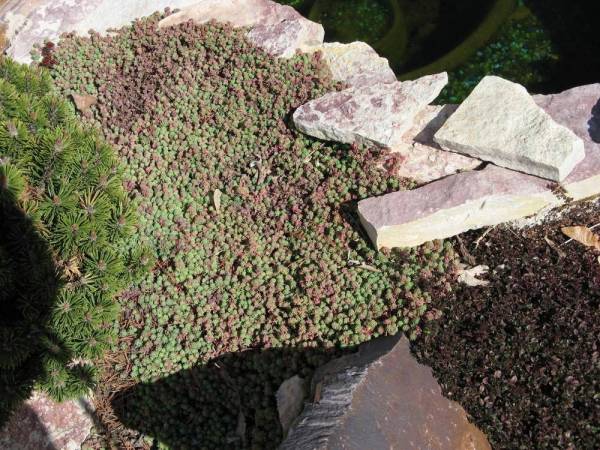
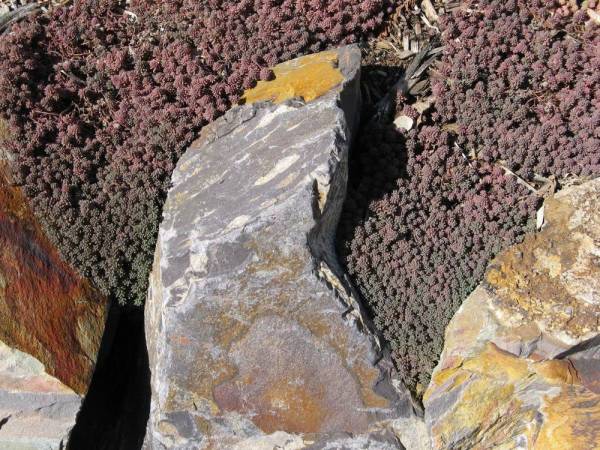
To view all my water garden pictures see here.
Using Pressure Treated Lumber in Raised Garden Beds
April 12th, 2009Short Answer: Yes, it is safe. Long Answer: Read On…
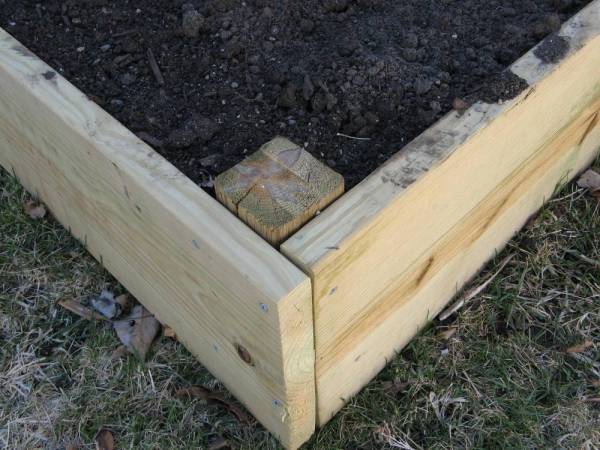
I am a man of science. I don’t believe in anecdotes, and having an analytical mind and having been exposed to rigorous scientific study in college when I was a research assistant in a lab, as well as of course the academic work in college, I’ve always looked at things scientifically, and today I’m going to look at pressure treated lumber.
Many people and sites and magazines will say you shouldn’t use pressure treated lumber, it is bad and will leach dangerous chemicals like arsenic into the soil and it’ll get in your plants and give you cancer.
Okay, there are a lot of assumptions there, and assumptions are bad.
I’m sure we all know the story of fish and mercury right? Mercury gets in the water and the fish drink the water, and since mercury and other heavy metals do not get metabolized, they can permanently build up in fish flesh (this is like lead poisoning in humans). Then predatory fish eat the little fish and they get even more mercury build up. Then humans eat the predatory fish and we get mercury poisoning.
So why can’t the same thing work with plants and treated lumber? Well you have to assume the lumber leaches dangerous quantities of dangerous compounds into the soil, then you have to assume that the leaching travels adequate distance in the soil, then you have to assume that the plant roots take up the compounds and do not metabolize them (remember, plants metabolize many dangerous compounds, house plants clean our homes of dangerous carcinogens) into some other compound. Then you have to assume that the compound is stored in the part of the plant that we eat and at dangerous levels.
There are a lot of assumptions, and just one break in the chain breaks the risk.
CCA lumber contains chromium, copper, and arsenic. Chromium isn’t that toxic and only if we inhale it. Copper isn’t toxic to mammals, and in fact it is used in some skin creams and whatnot. Arsenic is the bad one, a known carcinogen, something to be avoided. Did you know the Romans used to use it as makeup? But people didn’t live long back then anyways.
The truth is arsenic is everywhere, it naturally occurs in soil and water and we eat small amounts of it everyday. The type in CCA wood (inorganic arsenic) is more toxic than the natural types, but just for reference, it is already in the food you grow.
According to this article, which is an excellent source. Studies have been done showing most leaching only occurs during the first rainy season, and that it doesn’t leach more than a few inches from the wood. Then, most plants do not take it up from the soil, the ones that do in only small amounts, and the arsenic is stored in the parts we do not eat. For instance carrots grown in a control bed had 0.05 parts per million arsenic, those in a bed with CCA lumber had 0.11 parts per million, a doubling, but still a very small amount, and carrots were one of the worst (root vegetables in general were the worst since that is where the plants store arsenic).
So, is CCA lumber safe? Well, you can leave it out for one year letting the initial leaching get over. Then you can build your beds and line it with plastic sheeting or roofing fabric or some other membrane to stop leaching, and you can not plant root vegetables in it or near the sides of it where the leaching take place.
All told, by looking at the science, I do not think anyone needs to worry about growing vegetables in CCA lumber beds. Sure, you could use cedar, and pay 8x the price (if you can even find cedar in a 2×10 or 2×12 which is my preferred size), but CCA would be fine.
Should you go out and buy CCA pressure treated lumber to build your raised beds? Well no, you can’t. You see, despite the tiny safety risk, CCA pressure treated lumber was banned for consumer use by the EPA in 2003. Any pressure treated lumber manufactured for consumer use after that date has no arsenic in it. The ban all told was a better safe than sorry issue grown out of kids touching/playing on/eating off of/ CCA playground equipment, not garden contamination, but nevertheless, for the last 5 years pressure treated lumber has not contained arsenic.
So, for those worrying about it, don’t. Save yourself a few hundred dollars and get pressure treated lumber for your raised bed or other garden projects. It is cheaper than cedar, and worry free. Even if it still contained arsenic it’d be pretty safe, but it doesn’t even have that small risk anymore.
Save Paul James, Gardening by the Yard Cancelled, HGTV == Bad
April 1st, 2009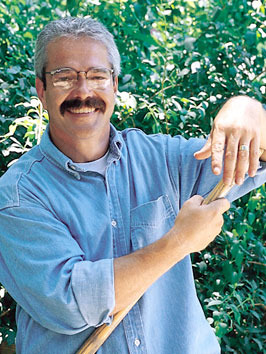
I’m angry.
Scripps Networks, owners of HGTV, are canning Gardening by the Yard and other gardening shows.
I want to swear and curse them out, I consider myself sailor quality in those activities, but this is a family blog so I’ll leave it to your imagination.
HGTV has forgotten the second letter in their name. As chronicled here they’ve been dropping gardening content for years, and little of what they do have is more like, as the link above says, using plants as design elements rather than things to cultivate.
Now they’re cancelling the one, one, educational gardening (as opposed to landscape design show) they have left. As you can read here they say.
They said gardening doesn’t sell and only old people garden. Well, we may be a seasoned, thrifty bunch, but gardening is still the #1 hobby in America.
This is a lie. Young people are in to gardening at unprecedented levels nowadays because young people are into being green and gardening, especially things like growing your own food, is green. There are 25 year old homesteaders out there trying to grow all their own food, this is not an activity for just old people. And with the economic crisis this has only increased. If anything HGTV should have made this move 4 years ago when people where all just interested in flipping houses rather than working the land, but to do it now when the pendulum is swinging the other way is ridiculous.
I am only 28 years old, I’ve been gardening all my life and I garden with a passion. Even for the few years when I lived in an apartment I had a patio garden (from the ground our patio looked like a jungle). I am smart, successful, young, technologically hip, and a big time gardener, and I’m not alone. So to say Paul James doesn’t appeal to young people is ridiculous. My youngest brother likes him too, he is only 20 and has been watching Paul James since he was probably 12.
I’ve learned so much from Paul. I would probably have not gotten more interested in dwarf conifers had it not been for him. I wouldn’t know what the heck a blue atlas cedar was had I not seen that beautiful specimen in his yard so many times. Paul taught me all about soil and especially about compost, I probably saw my first compost tumbler on his show. I’ve learned about vegetables from him, I’ve learned about trees. I’ve learned how to put in a rock wall, and how to build a fountain. And the only times I got close to bored was when Paul wasn’t on the screen.
Paul James is the Alton Brown of HGTV (or is Alton the Paul James of Food Network?). He is both entertaining and educational, a mix that is hard to find. He is the ultimate TV gardening personality (note to Paul though, this did not translate to your cooking show.). To say young people are not going to be interested in him as opposed to interested in a show where someone with a $30,000 a year income buys a $800,000 house? Or someone puts in a million dollar yard we can certainly all relate too? Please.
Is PBS going to be the only channel with gardening content? And what then, what do we have? Victory Garden which is slow and meandering and not nearly as entertaining (and invariably just about gardening on the coasts or at professional public gardens), or Smart Gardening which is so much filler content to fill 30 minutes? (“Today’s Smart Gardening Tips, exactly the same as last weeks: Choose the Best Plants, Water Well, and Have Fun!”)
If Paul James is cancelled he should get a show on Discovery Green. That channel is a little pretentious at times, and sometimes a little out of the mainstream, but I find myself watching it more and more. I think Paul would be a good fit there.
Either that, or, fulfill my dream of Paul, Alton Brown, and Les Stroud (Discovery’s Survivorman) going off on adventures together trying to live off wild foragables. That would be an awesome show.
There is a protest being organized to help save the show, don’t think it can’t work. Fans of CBS’ “Jericho” sent tons of nuts to CBS’ offices and managed to save that show for another season. Scrubs was cancelled by NBC, and picked up by ABC, same thing happened with Buffy. It can happen, show your support. The protest campaign is here.
Oh, date aside, this is no joke.
Oh, and if anyone from HGTV reads this. Paul James is the youngest person you have on your network. Age is not appearance of grey hair, age is a state of mind. And tell me, who acts more like a kid than him?
Kudos to Stark Bros
March 31st, 2009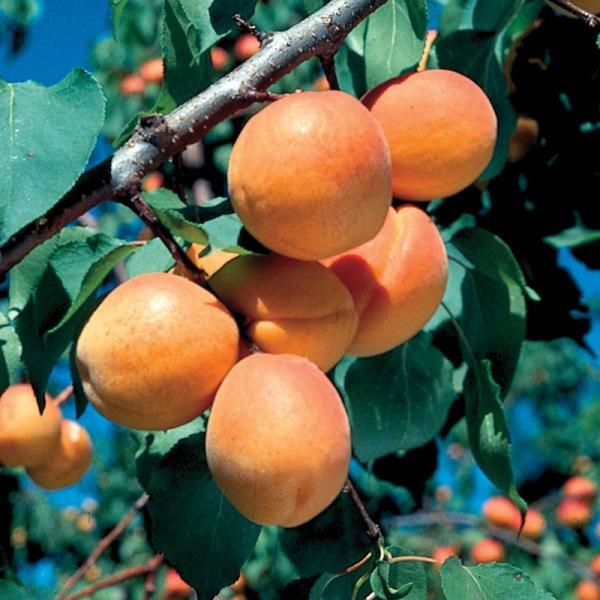
My first plant of the year has arrived, a ‘Goldcot’ Apricot Dwarf from Stark Bros, and I need to sing their praises.
I’ve talked up Stark Bros before, mentioning them as my favorite place to get fruit trees, but they beat themselves in quality this time. This dwarf apricot was around 4 feet tall, and nicely branched already. Considering it is a dwarf, that is a really nice size to get. The branching is important as well. Often you’ll get trees that aren’t much more than a trunk, and since fruit comes off tertiary branches that typically means three years of growth. With primary branches already perfectly in place (this is what I mean by nicely branched, Stark’s employees perfectly pruned the branches to create well spaced and angled primary scaffolds), it could fruit sooner. The yield won’t be large, but it’ll be something.
The tree also had really nice sized roots, and judging by the condition, it looks as if the tree had been dug and the soil washed off mere hours before delivery, obviously, thats not possible, but it looked so good I’m sure that almost no time passed between when they dug it at their nursery and when they had it sent out. This is important. Some places might dig weeks before sending, which can really hurt a plant (or kill it), so Stark’s seemingly super-quick time is a huge benefit.
If you need a specialty fruit tree, I highly recommend Stark’s as a place to shop.
Now, about the tree. Apricots are one fruit that really really benefits from allowing to ripen on the tree. They are picked, pretty immaturely, to be shipped to supermarkets because once ripe they have very little shelf life. By growing your own you can let them ripen and get a much superior fruit (actually, most fruit benefits from this IMO). I picked a dwarf variety because I didn’t want a big tree, I picked the ‘Goldcot’ one because it was bred here in Michigan so I knew it could take the winter. I also got the tree for my wife (yes, by the way, I am a man, I saw myself quoted on another blog today and I was referred to as “she”), I think apricots are alright, but she really loves them, and I’m a good husband, so I bought her a tree.
I also turned the process of planting into a how-to tutorial: How to Plant a Bareroot Tree.
Japanese Irises are Better than Bearded Irises
March 26th, 2009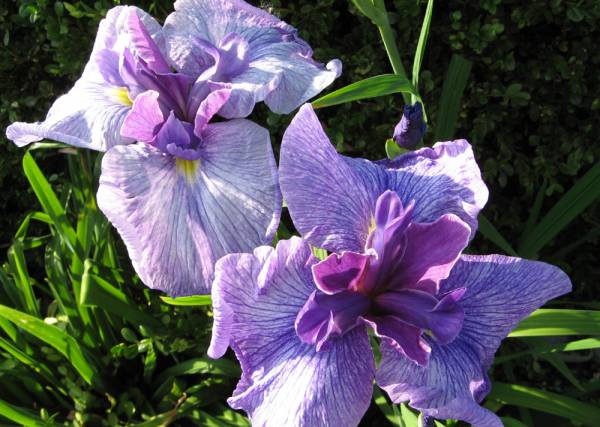
There can be no discussion, the Japanese iris is superior, in fact, I think I hate bearded irises now, and they used to be my favorite flower.
Bearded Irises, Falling Down on the Job
So, seriously, what kind of slob falls down on the job? The bearded iris, thats who! These beautiful flowers used to be my favorite flower when I was a novice gardener, they were big, interesting, flowers, and I liked big, interesting, flowers. But when I became more experienced and discriminating I realized all the shortcomings these plants have.
The tall bearded irises that are so popular cannot stand up to wind or rain, their scapes cannot support their flowers and any outward pressure will permanently damage the plant to the point where the flowers will adorn the ground.
They also don’t have the longest bloom time, big flowers are nice, but they could stick around longer. They also are finicky bloomers, sometimes they can just quit blooming until you divide them.
They also have ugly as sin foliage. Seriously, tall bearded irises have some of the most ugly foliage of any garden perennial. They look find when young, but as they age (where most plants improve) they get ugly. Big bald spots in the middle of a clump, so ugly. Yes, you dig and divide and try to give away the extras to family and friends who run in horror from yet-another-iris. This doesn’t excuse the fact that an iris put in the ground merely 3 years ago is going to be ugly this year.
Now, don’t get me wrong, the foliage is a nice bluish color, but it is just too sparse.
Japanese Irises, Fixin’ Whats Broken
Now lets compare with the Japanese irises. They have very tall (3-4 foot) clumping foliage that stays in a clump, looking like gladiolus, a bigger siberian iris, or a daylily on steroids. The foliage is attractive, and works really well at the back of a border. Additionally, there are variegated varieties.
The flowers of a Japanese iris are big, perhaps bigger than a tall bearded iris, they don’t really have much in the way of standards, but they have huge falls, they also in my experience last a little longer. Finally, they bloom later, around the same time as lilies, which is great. Lilies lack a strong purple color, and irises have that in loads. They’re of a height with lilies as well. So you can plant some purple Japanese irises next to some red lilies and have a really nice combination.
Did I mention they’re sturdy? Perhaps it is the clumping action that adds stability, but I’ve never had one fall over.
There isn’t as much variety available in the Japanese iris, but perhaps that is because they’re not as common, as people request them more, which they should, more varieties may be introduced.
In anycase, I can’t see a situation in the future where I would put a new bearded iris in my garden, and in fact will probably tear out more of the ones that are there currently. In contrast, I fully intend to plant more Japanese irises.
My First Bloom
March 15th, 2009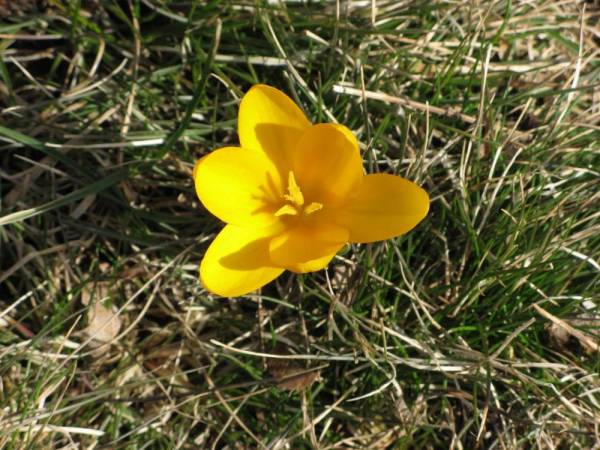 Lo and behold yesterday I posted that I didn’t have anything blooming yet, and then bam, this morning, a crocus! Two actually. My first blooms of 2009, and it happened on garden blogger bloom day.
Last year the crocuses did not start until April, so this year things are faster, but in 2007 it was the first week of March as I recall. So slower than 2007. Still, this bodes well for the year as a whole. Last year everything was so late I practically had tulips and lilies blooming concurrently.
Oddly, all previous years the first crocus was a purple, this year it is yellow. Today was a good day, I got out to do some yard work, I did pruning mostly. I pruned my pear tree, removing a lot of crossing or inward-growing branches. I pruned my kiwi and grape vines as well, and cut down my ornamental grasses. I also decided that to grow more food this year I’m going to put in two more raised beds, probably 4×12 each, giving me almost 100 more sq/ft of edible plantings. This beds will be on the north side of the house so not as much sun, so I will plant veggies that do not need as much sun such as cauliflower, beans, brussel sprouts, cabbage, etc.
Early Onions and the Miracle of Microclimates
March 14th, 2009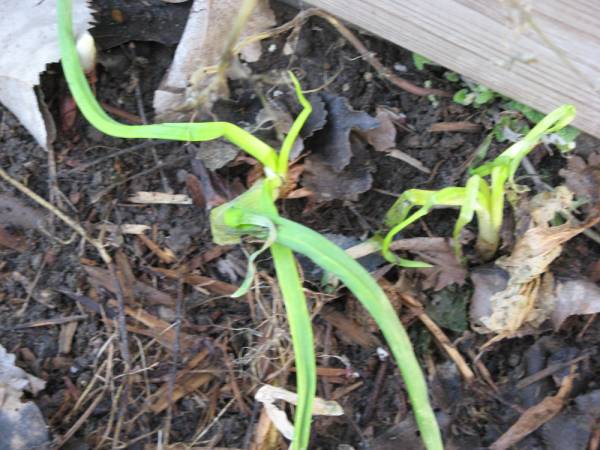 I’m a little sad. I read these garden blogs of people to the south of me, even one state south like Indiana, and low and behold, they are gardening! They have things blooming, they are planting, and woe is me for I am not.
It isn’t that I’m even in northern Michigan, I could drive south for less than 90 minutes and be in Indiana. It has just been so cold up here.
Finally today was the first day I could really get out and do things and inspect things because it was warm, but not wet, and there was no remnant snow on the ground. Still, the ground is frozen in most places.
My primary place for growing vegetables is the south side of my house. I grow edibles all over, fruit trees and berry bushes etc, but for actual vegetables, it is pretty much the south side of the house. This small area has a two-story solid white vinyl siding wall to the north of it. A 6 foot solid white vinyl fence to the east of it, a low hedge of shrubbery to the west, and a 4 foot wood fence to the south. Not only is this area incredibly sheltered, the sun bounces off all the white warming up the area nicely, and I’m sure there is some heat leakage from the south side of the house helping as well. All told, this is one kicking microclimate.
A microclimate is a small area, possibly as small as a few square feet, that has a different climate than the surrounding area. Shelter, a heat source, water, and elevation can all come together to help produce a microclimate. By building a good microclimate you can make zone 5 seem like zone 6 or even 7 (or, if you’re unlucky, seem like zone 4).
Outside of this microclimate, nothing is growing yet. My crocus foliage is only about 2 inches high, and don’t even ask about blooms. Inside of this microclimate, my lilac bush has very large swollen buds, and today I found that onions I planted last year have foliage that, when straightened is about a foot long. Outside the microclimate 2 inch crocuses, inside 12 inch onions.
I’ve always known it was warmer and sunnier there (hence, why I placed my veggie garden there) but I’ve never had such a good example of just how much warmer it is there. If I can find my soil thermometer I will take some measurements
Now, the onions. Last year was my first year growing onions. Around May or June with food prices being so high I started really kicking it into gear trying to save money by growing my own food and started planting edibles in odd places (with mixed results). Some of those mixed results were the onions, I cut back a 6 inch strip of mulch from the exterior base of my raised bed and planted the onions there. I figured the soil was fertile (if not tilled) from the runoff from the raised bed, and it couldn’t hurt. But still, I was planting late, in not-ideal conditions. The onions never did anything. Come fall most had died back, I pulled up a couple to see tiny little bulbs, and left the rest.
So these onions growing were planted late last Spring, some too have multiplied and though I did not dig them up, I can tell by the foliage that two sibling bulbs are now growing next to each other.
Since I’ve never grown onions before last year, I’m not sure what I should do here. Let them be and hope they put on more weight this season, dig, divide, and replant, or is their age going to limit them ever being productive? Anyone have a tip?
Low light, Houseplants, and Health
March 10th, 2009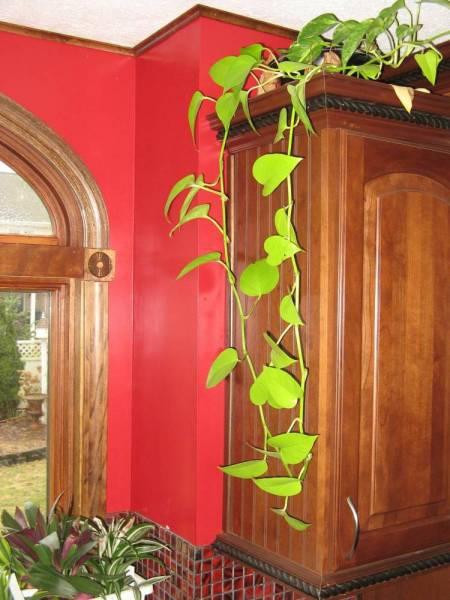
I’m laid up right now with a hurt back again, not much I can do, sitting hurts, doing anything active hurts, I can lay in bed with my laptop and an icepack. So, figured best to get some blogging done.
One topic that has been on my mind a lot lately is houseplants, I always start jonesing for gardening in the winter and usually end up buying houseplants around this time of year. I want more houseplants, but they’re hard for me to grow.
Did you know that houseplants have been linked to health? NASA has done tests showing how they remove pollutants, including cancer causing compounds. Numerous studies have shown that houseplants in the workplace reduce worker sick days and even over the long term the occurence of many times of cancer. The issue is called sick building syndrome and it is a big issue.
Unfortunately in my house, there are not a good number of places for houseplants. Not a single window faces south, and many rooms upstairs have just one window. Additionally, almost all houseplants I’ve tried to grow have ended up being eaten by our cats. The only one I’ve had any luck with, other than a cactus that can defend itself, is pothos.
For whatever reason since we bought this house I’ve not thought about hanging a basket from the ceiling. When I lived in an apartment the first thing I did was hang an ivy from the ceiling, but I never thought to do it here, until my wife mentioned it this weekend. I can’t believe I didn’t think of it, so that is my agenda, and that will allow me to place some planters near windows but not on tables (so the cats can’t get them).
But still, I want more houseplants. My wife is pregnant and I want to provide good clean air for our baby, and if NASA says the average home needs 14 plants, I’m behind, especially if they need to be dispersed. Plus, 14 was the minimum, no reason not to make it even cleaner. No such thing as too many carcinogens filtered out is there? My kitchen has a lot of plants. It has a big window (east facing) overlooking my garden and gets a lot of light (the most light of any room in the house). So I have 6 ot 7 pothos plants on top of the cabinets that then hang down. I also have others including some cacti in a windowell at that big window. But the rest of the house has very little. The basement is dark, the bedrooms are dark, the living room is dark, the dining room is a tomb (we need more windows).
I plan to plant more pothos, that plant is awesome. Reproducing it is as easy as sticking a cutting in a cup of water, and it takes abuse like crazy, and can be overwatered, but maybe I’d like a plant that grows upright or something?
The point is, I need plants that tolerate very low light, and mostly, I have a hard time finding them. Compounding the issue is that at many places houseplants are not adequately labeled. Some are sold with a light indication, others are sold without even a name that I could look up on the Internet to see.
So, I ask you, blog readers, anyone have a recommendation for a [u]very[/u] low light houseplant, that perhaps cats won’t eat?
PS, three of the best plants for cleaning your air are ivy, mother-in-law’s tongue, and peace lily.
Aerogarden International Basil
March 10th, 2009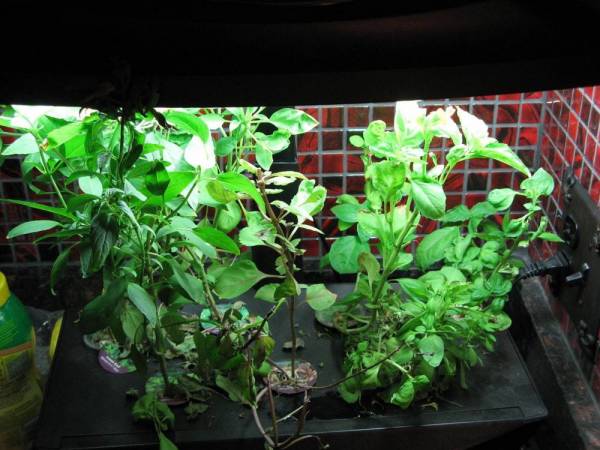
I’m still not a big fan of my aerogarden (see my aerogarden review. It would seem to me that mine has a defect as the back right pod, no matter what I plant in it, NEVER performs well. Also, the arm height for the light is woefully too short, I know I can buy an extension, but I’m reluctant to buy another part for it.
Right now I’m growing the “International Basil” seed kit, basil being one of my favorite fresh herbs to grow, probably my favorite fresh herb to grow. Not because it is my favorite herb, but basil, perhaps more than anything else, is infinitely superior fresh than dried. Other herbs such as thyme, rosemary, or oregano are fine dried, but basil loses a lot of flavor.
My favorite type of basil of the standard italian or genovese basil. This kit includes that, as well as marseille basil, thai basil, globe basil, napalatino basil, and lemon basil, and red rubin basil. So, as a service to the Internet, I thought I would write my thoughts on the taste of each.
Lemon basil tastes remarkly like lemon zest, to the point where a blind taste test might have someone calling it a lemon. It’ll be good to use in any dish that would normally use lemon, such as many fish dishes, and could also possibly be used in desserts and confections.
Thai basil is spicy with a strong fennel/anise/licorise flavor on smaller leaves. It isn’t my favorite, but I don’t mind it.
Marseille basil starts out complex and strong, and then fades to a soapy cilantro flavor. I hate it, I won’t eat it, much as I won’t eat cilantro, I’m one of those people who thinks it tastes like soap.
Napalatino basil is very mild, perhaps a more mild version of genovese, on big crinkley leaves.
Red Rubin Basil is pretty, with burgundy to purple leaf veins and edges, with a mild flavor very similar to standard genovese.
Finally, globe basil has small peppery flavored leaves.
Thats the lot of them, all told, other than the decorative value of red rubin basil, I can’t say any of these impressed me enough to grow them in addition to or instead of the standard genovese I always grow.
Garden for Dollars, Grow Asparagus
January 29th, 2009 One of my favorite things about gardening is that you’re making free food. Well, not exactly free is it? Anymore than anything is free. You spend the time, you buy the gardening supplies, fertilizer, etc. Many people probably do garden at a loss, I’m sure I do, but I enjoy it, so there is that.
There are plants you can grow, which, I think give you more bang for your buck than other plants.
For instance, in choosing a shade tree for your yard, you could plant an oak tree, or you could plant a walnut tree. Both drop nuts, but Walnuts are much more palatable to humans (though, you can eat Acorns in a pinch). Nuts are very expensive at the store, and having your own supply can save you big bucks. You’ll have to shell your own of course, but in the shell nuts keep for longer AND all those empty shells are compost fodder.
For a Spring followering tree you could plant a redbud, or other ornamental, or an apple or pear tree. Both give you flowers, and relatively small size (dwarf and semidwarf varieties are readily available), but the apple or pear tree give you fresh fruit as well. My pear tree planted in 2004 was bought for $20 at Lowes, and came about 6 feet tall, it is now around 20 feet tall and produced last year (it’s fourth year in my yard for those keeping track) around 40 super sweet ripe awesome pears. Big round fresh fruit can be as much as a few dollars per pound at the store. I’m not even talking organic fruit or stuff at Wholefoods or places like that. I shop at a regular old supermarket, and their apples can get as high as $2 each. $80 in production from this still very young tree is pretty good. You also get a higher quality product because fruit left to ripen on the tree does not ship very well, and in fact should be eaten within a day, but man oh man, it is so sweet and juicy.
I’ve also talked on this blog before about raspberries, my favorite edible for saving money, but I’ll admit it isn’t the most attractive plant, so perhaps not a good substitution as the others above were.
This blog post though, is about asparagus. Asparagus is relatively unique among veggies in that it is a perennial, not an annual. Now, from the standpoint of saving money, perennials are a bargain. You buy them once (or start them from seed once) instead of once per year. Additionally, because perennials establish root systems that go deeper and further than annuals, they need less water and less fertilizer. So the savings come all around.
Asparagus is also one of those plants that taste better when eaten fresh, after picking sugars in the plant start converting to starch, so the sooner after picking you eat it the better. And of course it is also fairly expensive in the store, so you’re getting more buck for your acre.
Asparagus I also find is fairly ornamental. The foliage becomes tall and airy, not unlike an ornamental grass, it also clumps somewhat, so I think it could be used the same way as an ornamental grass in an ornamental garden. Additionally it has some fern like qualities as well, but of course for full sun. See the picture with this post of some growing in a field.
The only downside with asparagus is that while you can plant it once and eat for decades, it can take a year for your first harvest. Depending on the size of the roots (and asparagus is sold bareroot) you will probably need to let it just grow the first year without harvesting (though, if some big mamajama spears poke up, feel free to eat them). See, harvesting stresses the plant and you want it to get nicely established in year one, in subsequent years if after harvesting you notice it start putting up weaker and thinner spears (pencil size or smaller) stop harvesting for the year. So generally, you harvest asparagus for a few weeks to two months in the Spring, and then let the plants mature and rebuild for the rest of the year until the following Spring.
I’ve grown asparagus for a few years now, but I am doubling my capacity this Spring because I’ve had good success with asparagus here and after trying other veggies in a certain spot I decided to just go with asparagus there as well. I shopped around and the best deal I found was at Park Seed (direct link to the product on their site). They have 40 plants for $29.95. That is pretty good. Also, both varieties are good (I grow them both). If you do not get this set, when shopping for asparagus male plants are priced at a premium, not because they taste better or grow better, but because the females can go to seed and then you’ll have volunteers all over your garden, which might not be your cup of tea.
To plant asparagus plant them deep, like you would a bulb, spread their roots out in a cone, like you would a daylily, and cover with enriched soil and fluffy mulch.
To cook asparagus, my favorite way is to boil for 3 minutes (exactly, cooking it too long is a bad idea), drain, and then transfer to a hot skillet with a little olive oil (or butter) in it, add the asparagus, squeeze in some lemon juice, toss in some lemon zest, and a little garlic, and saute for a minute or so.