
Weed Control & Dupont Lanscape Fabric
May 4th, 2011Some times it is cool to be a garden blogger, because you get swag. Dupont sent me free samples of their “Weedfree Premium Lanscape Fabric” to review, not knowing I already used and loved the product, and have for years. Free stuff for me.
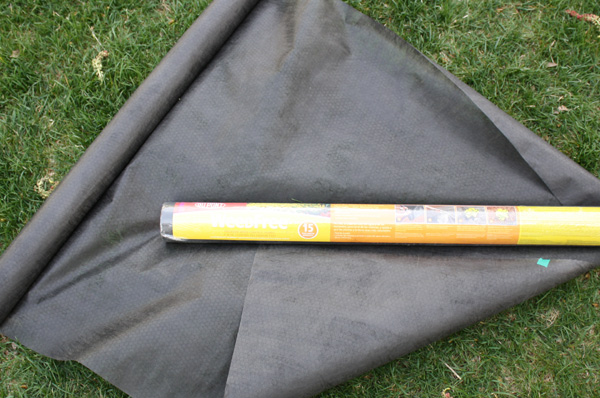
Free stuff for you too, they also gave me a $100 lowes gift card to give to someone who posts a useful comment to this post. I haven’t decided if I will award it to the most useful comment, or to a random useful comment (it definitely won’t go to a spammy comment). Of course, it’ll only work for people in the US. A word on my comment policies, if I get the impression your comment was made just to try to get a link, I will not approve it. Also, I doubt your parents named you “Lawnmower Service Seattle” so don’t put that as your name, it isn’t your name.
Moving on…
I’ve actually written about this landscape fabric before, back in 2006 in my article on how to mulch your garden. Though I did not mention it by name, it is what I use. I have also used it in videos or articles on making raised beds. Such as this article on making a raised bed with retaining wall bricks or this video on doing almost the same thing, only instead making a island bed in the lawn. I buy it at Lowes usually. I also get the Landscape Fabric Staples that go with it, very helpful for securing it to the ground.
So, I fully recommend this product, and not just because they bribed me with freebies, I really have used it for years. But it isn’t appropriate for everything. It is more expensive, but also far better, than black plastic (which you should NEVER use because it will decompose fast, and is not permeable) or cheap landscape fabric (which can fall apart). If you put down fabric, then put down 2 tons of pebbles, then come back in a few years to find weeds, you aren’t going to want to remove the pebbles, sort, fix the liner, and replace. You put this type of product somewhere you want to never have to touch again, so you don’t want to skimp on durability.
But, as I said, it isn’t appropriate for everything. If you put this under wood mulch, the wood mulch will eventually decompose, it will turn into soil, that soil will then allow weeds to grow ABOVE the fabric. There is no weed free solution for a mulch liner if you’re using an organic mulch that can decompose. The fabric literally lasts for decades, it lasts far longer than the wood chips you may put on top of it. So it does become an issue.
Use this under rubber, glass, stone, or other such inorganic mulches only. You also use it, as I did in the above video, to line the inside of raised beds to keep soil from leeching out, and you can use it as a liner under brick or cobblestone pathways.
I do not recommend using a durable landscape fabric in beds with perennials or other plants you will dig, divide, move, or harvest often (so no veggie beds either). This is for permanent or semi permanent plantings only. It is not for use with plants that spread, or that may be dug and divided regularly. It will get in the way in those circumstances.
For such perennial beds, or beds with wood mulch, I recommend newspaper and corrugated cardboard as underlayments, these are not permanent, of course, but the price is right and they last long enough to kill any existing weeds, then they decompose and add to the soil, so they aren’t in your way when you need to move something.
For permanent beds, with shrubs, trees, etc, or even maybe some perennials like peonies that don’t move or spread much, you can use this kind of liner, with an inorganic mulch please, like stone or pebbles. I find this is really good for foundation plantings up against your house, where you should not be using wood mulches anyways, to help protect your home from various pests.
You can also use it (though I don’t) as a mulch itself, put it on the soil, put nothing on top of it. Not the prettiest picture, but if you have a large veggie garden it may make sense between the rows.
Use it any place you put stone down really. I have this rental and the previous owner used a stone mulch in front but did NOT put a liner down. So over the years the stones mixed with the soil, destroying the effectiveness of the stone as a mulch, while making it a huge pain to dig or plant anything new in the area since it is now the world’s most rocky soil. Had he used a liner, I would have merely needed to peel back the liner.
Please feel free to share any tips you have for working with this product in the comments, or for weed control in general, and by mid May I will have devised a way on how to reward the Lowes gift card.
FAIL! My Fargesia Nitida Bamboo is Flowering.
April 21st, 2011Woe is me. My bamboo is flowering.
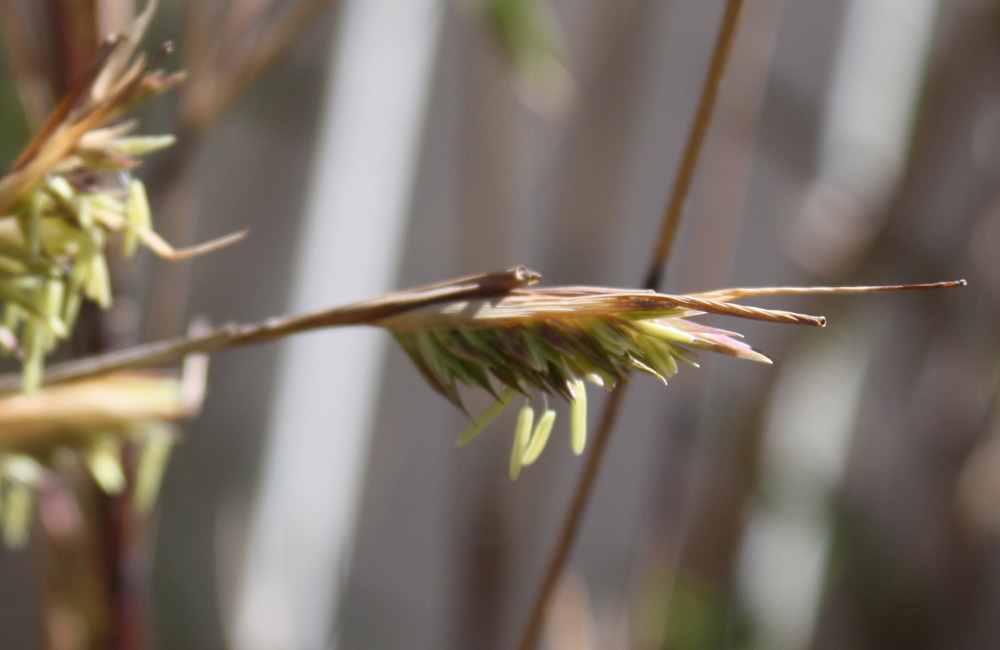
Bamboo Flower Close-up
Now, up where I live, there is only one bamboo that can really grow. Fargesia Nitida, a clumping Chinese mountain bamboo that is hardy to zone 5.
The thing about bamboo, it doesn’t flower, it doesn’t flower for decades, a century, then it flowers and dies. this makes it very very very hard to hybridize bamboo because the generation period is so long.
It also has a bit of a plant memory, when you take a clone, a cutting, from bamboo, it isn’t “born again” it is the same age as the original. So my 6 or 7 year old clump of Fargesia Nitida, which was finally getting big, was really like 100 years old since it was an original from the first discovered clump. I knew this was possible, because Fargesia Nitidas have been flowering worldwide in recent years, but I was hoping…
Anyways, so now it will die, because once bamboos flower, they die. The seeds can be valuable though, because, they’re a once in a 100 year harvest. But I will have to start all over again, and that does kind of suck.
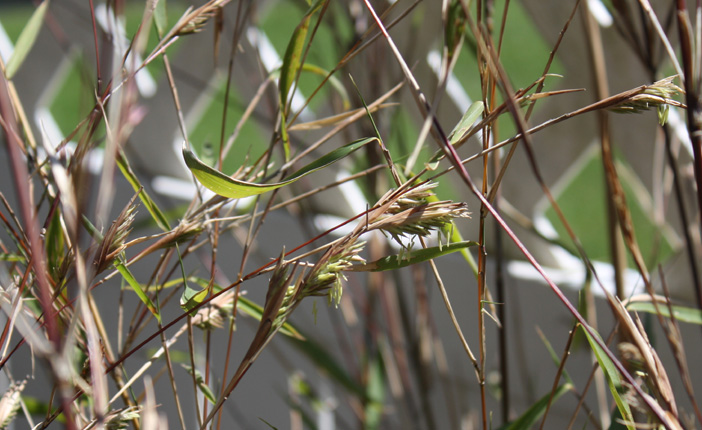
Bamboo Flowering
I may end up sharing some of the seeds, or keeping them. I don’t know. Maybe I’ll store them until I move for planting at my new house (in like 5 years). I do really like this plant, and I recommend it. If you shop for it though, make sure you know if you’re getting a new seedling version, or an old clone, because old clones could flower and die on you in just a couple years.
Not Gardening
April 19th, 2011It has been a long time since I’ve posted anything, I didn’t want people to think this blog is abandoned or anything, but, by nature, gardening blogs are largely seasonal. I’m not so lucky to live in Florida where I can garden year round, or near enough as makes no difference.
I haven’t been able to do much gardening this year. We had really cold weather, then in mid March a surprise warm up, short lived, but it was enough to get my first blooms up, crocuses. March 17th. In 2010 these exact crocuses were also my first flower of the year, on March 16th. The previous year the first flower was one day earlier yet again, March 15th, though a different clump. Obviously the world is getting colder or something. That is eerily consistent.
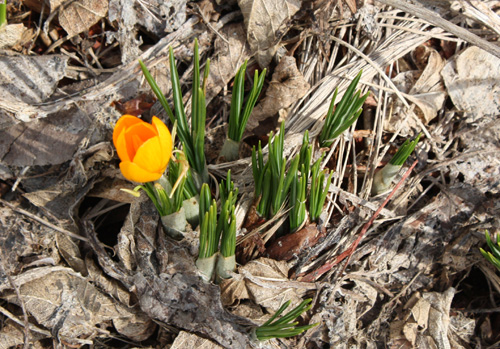
Since that brief warm up it has been more cold, more, ran, more cold. Yesterday we had snow, and not a light snow, heavy, significant snow. Snow on April 18th. What is more, no tulips, no daffodils, no irises, not even close. A little hyacinth action I’ve seen but even the forsythia’s have only a minor yellow shade to their buds as of yet. We’re way behind so far.
Last year was a really horrible summer here. June was all cold and overcast and too much rain and not enough sun, July was okay, but then August was too much sun and not enough rain. We got a late start, again because of cold, and in fact I got no yield on my kiwi or my apricot because of a late frost zapping buds, grape yield was also almost nil. Now I fear it again as we again have a very cold Spring thus far. Though I hope things will change and we’ll get warmer than normal temperatures now, as a recompense.
However I cannot help thinking about coins. One might flip a coin 10 times and have it come up heads all 10 times and think to oneself that number 11 must come up tails, because it is due. But in fact statistically the chance of toss 11 being tails is the exact same as the chance of toss 1 being tails. The coin itself has no memory and cares not for any streak it may be on. So I fear it may be with the weather. I think we may be due some good weather, but I don’t know if mother nature cares about what we deserve.
So, I’ve done very little gardening, nothing really to write about, a little pruning mostly. I did do more limbing up of a spruce to free up a massive amount of square footage in my backyard, allowing for a larger deck and room for a playhouse for my kids. The spruce had provided some privacy though so I planted some “Green Giants” along the fence to eventually take over the screening job the spruce had been doing. I also planted a cute little weeping larch (like a weeping atlas cedar for northern climes, hardy to zone 3, but with green needles in contrast to blue on the atlas), I had ordered online when I thought the weather was turning (I was wrong, so now it has needle scorch – having been shipped to me from a warmer climate).
I haven’t even started any seeds, because doing so outside would be futile because of the weather, and doing so inside would be almost futile due to the kids and cats.
But I am still here, as is this blog, and I will find things to post about when we finally get some better weather.
Stark Bros Coupons
January 3rd, 2011If you read my blog you know that Stark Bros is my favorite place to buy fruit and nut trees, they have an excellent selection and quality products. I have bought numerous trees from them over the years.
They recently sent me three coupons to pass along, so I’m going to do that here. The coupons are for $5 off $50 or more, and each can only be used once. Not the greatest coupon in the world, but I figured someone might want one. So the first three people who use them, will get them, as it were. If you try the first code and it is rejected, it means someone already used it, so try the next one, etc. It’d be helpful if people commented when they were used up, so I can edit the post.
If you don’t know what you should get, let me make a recommendation. Buy a honeycrisp apple tree. The apples are huge, and delicious, my favorite apple. Plus, they’re expensive. Around here they’re $3 a pound at the store, double what other apples are. The stores charge so much because people are willing to pay it, they’re delicious. The Cadillac of apples. If you’re going to grow apples, might as well grow the most valuable kind eh? Stark’s has them in dwarf, semi dwarf, and normal varieties. So there is a size for every yard.
The coupons:
Promo code: 11CA1005
Coupon code: GROW-8RBBAUR6W6WDY
Promo code: 11CA1005
Coupon code: GROW-Y34WX4VVQXDSL
Promo code: 11CA1005
Coupon code: GROW-6SC9S5TCBXHC8
A Pruning Tool for Every Job
December 16th, 2010It has been awhile since I’ve blogged, but the end of the gardening season (due to earlier than normal harsh cold weather) and a new baby will do that to you.
When I was getting my garden ready for fall I had to do some pruning and cutting back of various plants and it occurred to me that I had a lot of tools for the job, each with a slightly different purpose. I thought I should do a blog post about them, explaining why I own each, and what they’re used for. Maybe it is not too late for Christmas to get some gift ideas from this list.
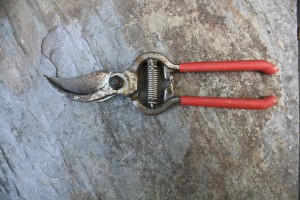
These are the old standby universal pruners. They work by having a blade pass by an anvil or stop. They produce clean cuts better than hammer pruners which can crush the ends. They can wear out though and require maintenance every once in awhile, I tend to just buy new ones, though I feel bad when I do it. These are best used for small tasks like deadheading roses, or cutting unwanted dahlia blooms. You can also use them for harvesting some vegetables like grapes or squash.
I actually prefer a different style though for my bypass pruners. I like the Fiskar’s powergear style, much more power available. I apparently forgot to take a picture of my set, so I’m borrowing from Amazon. Mine also has a titanium blade, and they are my favorite pruners for all small tasks.
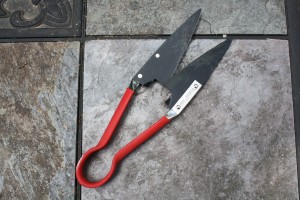
Yes, seriously, sheep shears. These open and close very fast, far faster than spring loaded bypass pruners. They are excellent when doing many small cuts like for topiary, or for harvesting small vegetables like beans. I also use them to trim back the new growth on some ivy when it gets to where I don’t want it. They don’t have the power to trim more rigid or thick things, but for fast cutting of small things, they are a great tool.
Offset Pruning Scissors
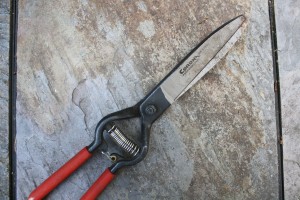
I’m unsure where I bought these, but they are offset pruning scissors, kind of like a cross between the sheep shears and the bypass pruners above. I use them a lot when I need to cut something out in the garden, like a plant tie, but they can also be used when you want to do a topiary and need something that will produce an even, flat, surface. I also use them sometimes for harvesting. Though, they’re not as easy to use one handed as the sheep shears.
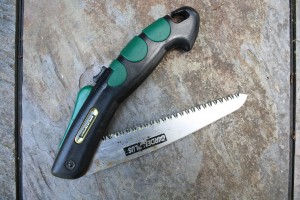
These are a must for pruning anything that is too big for hand pruners. Like 3 inch tree branches for instance. It takes some elbow grease but the large saw teeth make short work of most woods, then the saw folds up for easy carrying, in your pocket even. The saw also happens to cut drywall passably well (if not neatly).
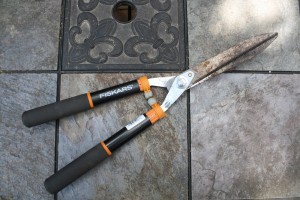
When you’re doing large hedges, this is the standby pruner to use. The larger handles also allow you to get more leverage allowing you to sever thicker branches without resorting to a saw like above. They also come in handy when you need to prune back something hard, like say growth at the end of the season for something you prune back every year like a butterfly bush. I also use it to help remove daylily scapes in late fall. Finally, with plants that need to be pinched back like mums or some sedums, I will just lop off the top inch of all the stems with this tool to save time. Next to a good pair of bypass pruners, this is the second most important tool for your pruning arsenal.
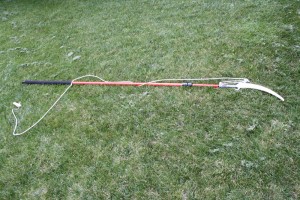
This is the tool that has no substitute. Sometimes a step ladder isn’t enough and you need to get really high. If you’re on the ground you can prune branches as high as 20 feet, if you’re on a hill, a ladder, or a roof, you can get even higher. This tool has a lever action lopper on one side to cut 1 inch (or so) branches, and a pull action saw on the other. I’ve cut branches as wide as 8 feet thick with this saw, it was a super intense shoulder workout, but I got it done. If you have trees, owning one of these is far cheaper than hiring a tree guy.
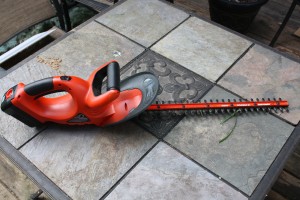
Now the power tools. This is your standard battery operated hedge trimmer. I like the battery operated ones because cords are annoying, and so is gasoline. Sure it needs battery replacement, and I don’t always have the power to do my entire yard at once (assuming I even want to) but the battery lasts for say a good 30 minutes of cutting, and because I own multiple items in the Black and Decker line I have multiple interchangable batteries, so I can make sure one is always charging. You can use this item for pretty much anything you’d use your hedge sheers for, this just takes less muscle and is faster, and the longer cutting blade allows you to more easily to straight/flat cuts on large hedges.
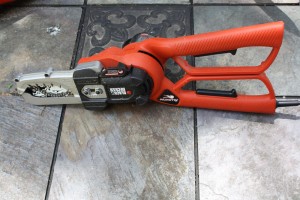
Chainsaws are incredibly dangerous, every year thousands of people seriously hurt themselves. The Black and Decker Alligator Chainsaw makes it safer with the mouth design and blade guards. Unfortunately I don’t really like this tool. The one I have is corded, which is annoying, very annoying. The chain also falls off the track constantly for me. I don’t know if it is my fault in improper usage or bad design, but it takes at least 5 minutes to put it back on, making this tool a labor to use. I would almost always rather use a handsaw. So I rarely use this. I’m sure if it was battery operated and the blade would stay put I would use it far more often. There is a battery operated one available.
Trees as Time Capsule
October 16th, 2010I romanticize about gardening and landscaping sometimes, and I’m sure I’m not the only one. I often fantasize about what impact I can leave on this world, what I can build that will exist after I am gone.
Trees live for hundreds or thousands of years, and since they reseed, your actions in planting a tree, even if the tree doesn’t live that long, can affect the environment for, well, forever so long as man doesn’t get in the way.
There is a small public wetlands/park area by my house, it is public land and is completely enclosed on all sides by development. It is probably about 1 square mile and is trisected by walking paths. I’ve planted wild flowers back there before, and I know other locals have too, even a few trees. Some guy has put up bird houses. The people who live by it tend to take care of it.
It is the perfect place for bald cypresses, none of which grow near it, and which are beautiful trees that get quite large, and can live a long time. I know they can live in this climate, there is one in town someone has in their yard that is probably approaching 70 feet. I bought some seeds on eBay that I will start them into the Spring after I have given them the necessary cold treatment. Then, one they’re growing, next summer or fall, I will transplant them back into that area and pray the couple deer don’t eat them.
I won’t live in this area forever, I’ll probably move in 5 years, so I won’t get to enjoy the trees once they grow (if they grow) but someone will, and the animals will. In a hundred years, I will be gone, but those trees could still be there, and people may wonder how bald cypresses ended up growing there East Lansing Michigan. Well world, it was me, I did it.
My parents live a few hours north of me in a rural area and live more or less in the middle of the woods. There are a lot of deer, a lot of deer, rabbits, turkeys, opossums, raccoons, all the woodland animals. But not a lot of squirrels. There are also no oak trees in their forest. I have no idea why, but there isn’t. They have a lot of birch, of poplar, of hemlock, fir, and spruce, but no oaks. Meanwhile, down here in the suburbs where oaks have been prolifically planted, we have squirrels all over the place. I have always thought it was odd that more squirrels should live in the suburbs (where they get routinely flattened) than in the forest.
So I collected a bunch of acorns and sent them up for my brother who still lives at home to plant. Trees grown from seed always grow faster, especially initially, than those grafted. Additionally, with oaks, when grown from an acorn they have a better chance of growing a good taproot, thus being stronger and harder to uproot. To plant them you just pretend you’re a squirrel and dig down 2 or 3 inches and drop them in like you’re hoarding for winter (the same deal with walnut or pecan). Not all will grow, but some will, and if they mature they will be the first oaks in the forest, perhaps eventually spreading and colonizing more areas. The trees will provide habitat, and the acorns food for many forest animals. The squirrel population will explode.
It will be many years before that happens, the house may still be in my family, though, and even if it isn’t, the oaks will be providing wildlife habitat, I will have changed the local ecosystem like Johnny Appleseed, the effects of which could be felt for hundreds or thousands of years.
I’m sure there are some people who think “interfering” in nature is wrong, but I’m not one of them, if I want to plant a tree I’ll do it, it isn’t as if I’m planting something invasive. They may not naturally grow in the area, but they wouldn’t be wholly out of place. It is one way I can change the future, and I think that is pretty cool.
How to Grow Hardy Hibiscus or Rose Mallow
October 11th, 2010This is a plant with many names, hardy hibiscus, rose mallow, swamp mallow, etc. It is a wonderful plant and should be in almost every garden.
A North American native it can be found growing wild in the south, but it has been hybridized and many beautiful cultivars are available for the entire country. It is related to the tropical hibiscus but is hardy and has much larger flowers. These flowers can get to a foot across, a full 12 inches, outside of dahlias, which are a huge labor to grow, what else gets so big?
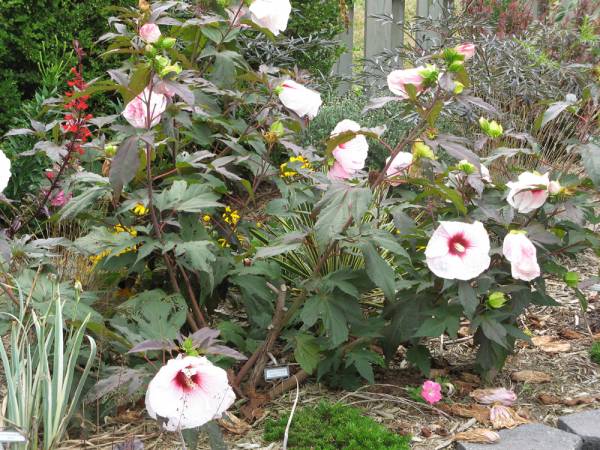
Kopper King
These plants are fairly carefree. They need sun, and water, that is about it. I’ve given some to my Mom and while deer eat most other things I’ve given her, the deer near her house (and she has a lot of deer) have never touched these. Maybe, because they’re native, they evolved with deer and so have defenses.
They get a late start in Spring, I often worry they have died (and I sometimes protect them with a styrofoam cone to allow them to get an earlier start, but they don’t need it), by late May they’re growing, reaching as high as 4 feet by late summer, then the blooms come. Mostly in shades of white, red, and pink. The plant also has a very pleasing golden fall color to the leaves.
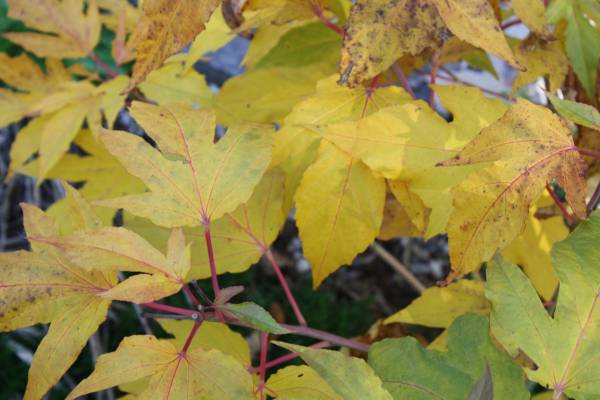
Kopper King Fall Color
Standard hardy hibiscus have heart shaped leaves like other members of the mallow family. However some hybridizations have occured for leaf interest as well. My favorite of the lot is called ‘Pinot Noir’ it has very deep cut foliage remisicent of a Japanese maple, the leaves are also mottled green and purple, though the purple is very subtle. There is also ‘Kopper King’ which has three lobed leaves like a standard maple that feature a bronze or burgundy sheen. I also grow a variety called ‘Turn of the Century’ that has green leaves otherwise deeply cut like ‘Pinot Noir’ or maybe even more so. ‘Turn of the Century’ also features striped red and white blooms that look like peppermints. Finally I grow a white one that I’m unsure the cultivar of.
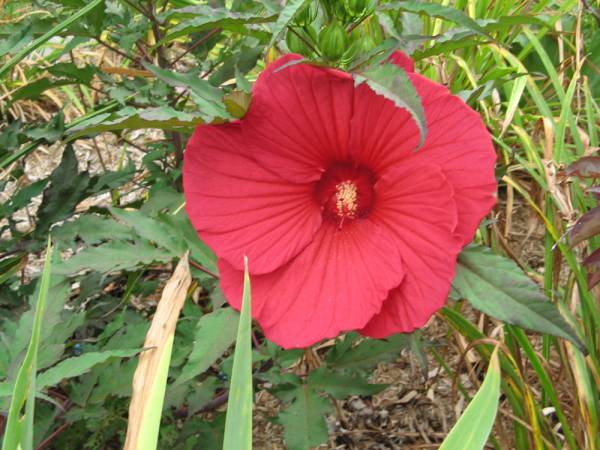
Pinot Noir
Of the four I grow ‘Pinor Noir’ my favorite for it’s deep red blooms and colorful leaves, is also the hardiest, and the best grower for me (though perhaps that is my fertilization bias). We had a spat of cold weather about 10 days ago with our first frost. It affected the other ones slightly, but ‘Pinot Noir’ is still sitting pretty like we’re in mid August.
In the Spring or early Winter after you’ve had some hard freezes you should prune back the growth to the ground, those canes are dead and you don’t need to keep them (this isn’t a hydrangea).
Make sure the plant gets plenty of water when growing, and they should grow well, with plant and bloom size being related to soil fertility. I also have anecdotal evidence they like banana peels, I toss a few into my garden daily, and the plants really seem to respond to that potassium.
All told I can’t recommend the plant enough. It is easy to grow, carefree, and provides showstopping blooms. It is also very easy to start from seed, every year one or two volunteers crop up in my garden (enough to be a bonus, way too few to be invasive). After blooming small seed clusters develop which eventually turn brown and crack open, harvest the seeds then and try planting them, maybe you’ll discover a new color! Or perhaps, you’ll just get free plants.
Front Yard Farming
September 3rd, 2010I’ve seen articles recently about global food shortages and feeding our populations and whatnot, bunch of scare tactics mostly, but when you sit down and think about it, there is a lot of land that could be used to grow food, but isn’t.
Highway medians, roadsides, parks, but mostly, front yards.
Some backwards and oppressive cities have ordinances requiring you to have x percentage of front yard as perfectly green lawn, and if you try to put in garden beds, xeriscaping, or just don’t remember to water, they fine you.
Garden beds require less fertilizer, less water, and less labor than lawn, and can make you money when used right. Sure, kids can’t play in gardens like they can on lawns, but unless you live on a very low traffic street, you want them playing in the back yard anyways. On my street, which is 4 lanes, I put in a new super secure gate as soon as my son learned to walk just to make sure he can never go into the front yard.
So, assuming you don’t live in a third reich city and can plant your front yard as you wish, why not get rid of the grass and put in planter beds? On a side note, I think it is funny the same sort of people who put in the stupid lawn ordinances are the types who act like chicken littles about food shortages.
My front yard is full of planting beds and I add a new one or two every year (it is almost an addiction for me).
I grow a mix of ornamentals and edibles in my front yard, I’m too much of a landscape artist to fully commit to just utilitarian gardening like I showed in this blog post on growing your own food. Plus, I want to sell this house one day (probably in about 5 years) so I have to be cognizant of resale value.
Right now, in addition to the sweet potatoes, apple trees, pawpaw tree, and herbs I am growing in my front yard, I’ve got a ginormous 15’x15′ mound of butternut squash. My wife calls it “The Blob” and we always see people walking by scoping it out. A few years ago squirrels told me where to plant my squash and so I did so this year. Butternut squash are versatile in the kitchen, and fairly easy to grow. A little supplemental watering if there is a drought, and that is it. They can be affected by powdering mildew, so a fungicide can be helpful, but they are one of few squash varieties resistant to squash vine borer.
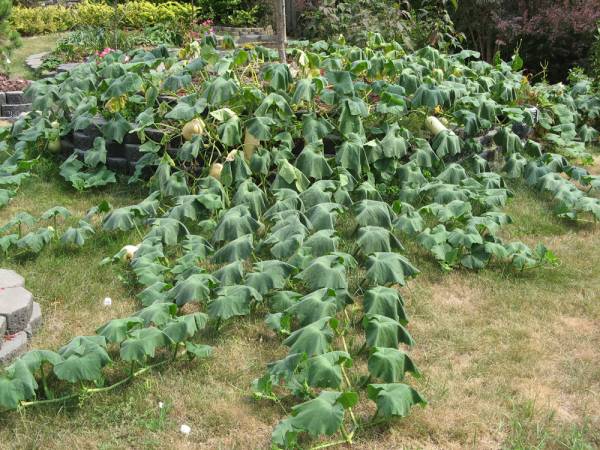
I’m letting the blob grow all it wants, I’ll just mow around it (not that I’ve had to mow, we’ve had a drought lately, hence the wilty leaves). I’ll probably get 60 pounds of squash off of these plants, all for the price of a pack of seeds. It might not be the most attractive thing in the world, but a squash vine is not a permanent landscape feature, it can be removed at any time. So to grow it or another vine (such as watermellon) in your front yard all you need is a small planting hole/mound (with improved soil please), and then let it spill over onto the grass, and mow around it. Unlike a crop like say corn, you don’t have to commit a large portion of your yard to permanent garden if you don’t want to. You could also grow pumpkins this way as a project for the kids.
For most squash you don’t even need to start them until June (or even later if you have a longer growing season than we do in Michigan), and they take a little while to get going, so it isn’t as if it’ll cover your yard for the entire summer either.
My Favorite Tree Died, A Lesson in Plant Biology
September 2nd, 2010My favorite tree has died. I have blogged about it a lot, and the posts will be mentioned below in the related posts section.
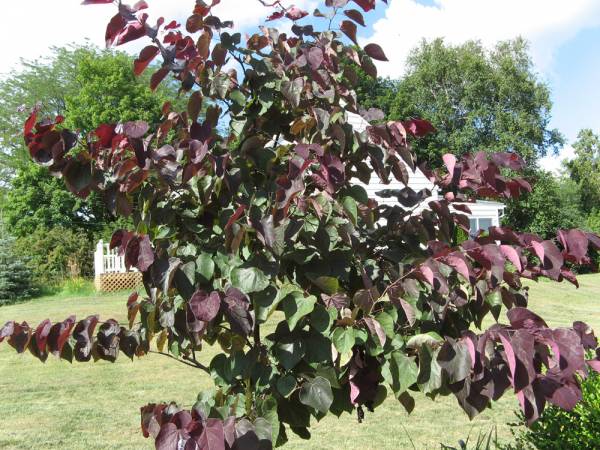
It was a Forest Pansy Redbud. I’ve had bad luck with the spot that I planted it. It is very full sun, from dawn to dusk, I had two weeping cherries die, but I think they were infected with bacteria at the nursery, then I ordered a redbud mailorder, and grew it for a year, and spring came and the blossoms were the wrong color, so I gave it to a neighbor, and finally bought my Forest Pansy.
In Memoriam
This tree was really great, it has a fairly unique purple foliage color, not red, or burgundy, but purple. In addition to the typical redbud pink flowers in spring. I like trees and plants with more than one feature. So both leaves and flowers.
I was so excited at how well it was doing last year, very full with leaves, nice color, growing great. Then a wind storm came and it had grown too great because branches were too heavy and the trunk split. I blogged about this and tried to fix it. I was able to maintain the current foliage last year after the damage, but the leaves on the weaker half never grew this spring. So I cut that half off.
Then we had a hail storm that damaged all my plants with large leaves, like redbuds. So the tree was looking really straggly.
Then we’ve had a drought for 2 months that just ended today, just one barely rainy day that whole period.
This is where the plant biology comes in. Redbuds like shade, they are an understory tree that likes to be sheltered by big oaks and whatnot. My spot, as I said, is full sun, and Redbuds can grow there, mine did very well in 2009 and before, but they need moisture.
Plants leaves lose moisture based on sun exposure and heat, the more direct sun, and the hotter it is, the more moisture they lose. If you’ve ever seen a squash plant on a hot summer day, with the wilting leaves, that illustrates the point. With squash the leaves will recover during the night or after a watering, some others, like a redbud, will get crispy and scorched.
So, in general, plants that prefer shade do so because they have a hard time providing enough water from their roots to their leaves when in full sun. Think of it like the water is actually flowing, if the flow rate out of the leaves is greater than the flow rate up from the roots, the leaves wilt and could scorch or die.
So, my redbud was able to thrive, despite being in sun, because I kept it watered.
This year, during the drought, I kept it watered as well, but it wasn’t helping. After I cut it down I discovered why. At one cross section, because of the split trunk damage and a previous scar from before I bought the tree, 80% of the tree’s cambium layer was dead. This is the layer of green flesh directly below the bark where trees do all of their “living.” So the roots had access to water, but there was a bottleneck getting it up to the leaves. I knew the cambium layer had been damaged when the trunk split, so I did a lot of pruning of the leaves to try to keep things in balance.
Unfortunately, even with the pruning, the tree could not stand up to the two months of heat, constant sun, and less water. There was to much cambium layer damage, for a tree that really needs to be at it’s best to handle full sun.
So I cut it down. I’ll plant one again some day when I have a different house with a spot for one in shade.
To replace it I waffled a lot, I kept going back and forth between different ideas. First I wanted a pine, but something tall and narrow. Then I decided I wanted a columnar maple, and really got interested in a “Newton Sentry” maple which is this really neat tree that grows 60 feet tall but only 6 feet wide. However, the only source I could find had short ones, and if I know we’ll probably be moving in 5 years I would never see it get to it’s potential.
Then I thought about doing a chinese red birch, because the bark is amazing, but I couldn’t find any source for those except seeds, which of course would take a really long time.
I finally decided on a “Royal Frost” Birch. This tree has burgundy foliage and interesting white peeling bark, bit of a standard birch, but at least two points of interest on it. I was able to get a 14 foot tall one for only about $60, which was by far the cheapest option in a price to foot comparison from among the ones I had shopped around for. It doesn’t have much trunk caliper, but it is tall. My forest pansy had a beefier trunk, but wasn’t more than 7 feet tall. So this fills the space well.
Birches are often sold in single trunk or multiple trunk forms. Some people like multiple trunk forms, or “bushier” forms, I’m not sure why, but multitrunk birches don’t grow as tall. Considering I was going for something tall and narrow, I went with a single trunk birch, so that it’ll grow narrower and taller. But if you ever buy a birch mail order or something, make sure you know what kind of trunk form it has, because many are trained to be multitrunk.
Juvenile Cardinal Fearless & Frolicking
August 31st, 2010Cardinals mature very fast, just a week ago (maybe less) I saw this cardinal learning how to fly, it had just left the nest. Yesterday, while filming something else, he came to visit, and got really close to me. Since I had the camera ready I decided to film him, it is so rare to see cardinals at this stage of development since they are at it only for a short time.
This little guy had no fear of me, and at one point flew down within inches of my feet. Watch the video below, or at Youtube for HD. Also included are partial shots of my water feature, and this just underlines another reason to have a water feature, they attract wildlife like nothing else.