
Zucchini Plants Dying from Squash Vine Borer
August 3rd, 2008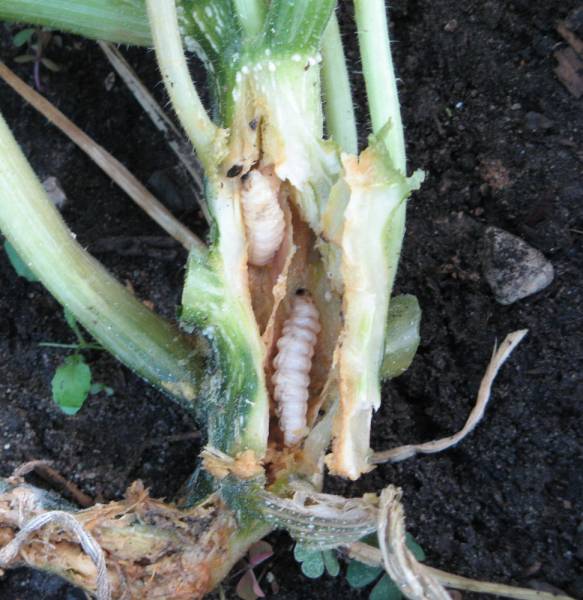 So, I tossed two of my zucchini plants in my compost tumbler yesterday, when pulling them up I didn’t need to uproot them, the squash borers had basically destroyed the main stem to the point that the top of the plant was hardly connected to the roots at all.
I knew it was squash borer damage, I had seen the tell tale signs of the orangish sawdusty wounds around the base of the vines, but I also knew it was too late by the time I noticed. But, this morning, I went out and did surgery on my remaining squash vines, and look what I found. You can cut the vine lengthwise, opening it up, and remove the borers manually, there will be small ones, the size of a couple grains of rice, and possibly big ones as you see. Ugly little things. They’re like big grubs with black heads. They burrow through your vine, killing it, then overwinter in the soil in a cocoon, to emerge in June as a giant fly-wasp-moth-thing and destroy your current crop.
So, after infestation, you can control it with the surgery as I explained, then immediately cover up the cut areas with a mound of dirt to protect it and hopefully encourage new rooting. You can also make sure leaf nodes further up on the vine root by putting mounds of dirt on them, this will mitigate the loss if the borers destroy the main vine. If you catch it early enough, when they’re still little orange or brown eggs on the vine OR have not yet made it inside, you can spray the vines with an insecticide and kill them. You can also go after the adults.
As I said the adults are giant fly moth things. They literally look like the biggest flies you have ever seen, or a type of wasp, with hairy legs, but they’re a type of moth (just with clear wings). They often have red or orange markings, but the ones around my house seem mostly black. They can be seen on or around the plants at various times in the day, especially evenings, and should be attacked and dispatched in your most ninja-esque fashion.

If your vines have been compromised, you can put them in a compost tumbler, but I would not put them in a compost bin or pile. In a tumbler you’ve got a more or less enclosed contraption that gets very hot in the inside AND is not open to the soil at the bottom. This should prevent any larvae from surviving. In a free form pile or bin where it is open, doesn’t get as warm (or turned as often & violently), they could probably survive to torment you next year. So if you do not have a tumbler, I would burn the vines, and as soon as possible after removing from the garden. You don’t want any of the larvae to escape and burrow into the soil.
These critters will attack all members of the squash family, so that is summer squash, hard winter squashes, pumpkins, etc. Apparently ‘Hubbard’ winter squash is the most susceptible, and butternut squash the least. One solution some gardeners do is to plant ‘Hubbard’ early in the season as bait, and then once it gets infected, pull it up and burn it. I’ve also read that wrapping nylon or another barrier around the stems can help as well. Personally, I think I will just spray with an insecticide. I try to do things organically and healthy and everything as much as I can, but I’m not broadcast spraying, I’m not spraying the parts I eat. I am only going to be spraying very specific spots on the vines. I’ll be using Sevin, others that work are apparently methoxychlor, rotenone, pyrethrum, and malathion.
Apparently their only natural pedator is wasps, which only get them as eggs or before they bore into the vines.

August 3rd, 2008 at 9:27 am
Thanks for the information. We’re off to check our zucchini now! YIKES!!
August 3rd, 2008 at 1:21 pm
I’m sorry they got your zucchini 🙁 Ugly little (big) things too. Yuck!
August 14th, 2008 at 8:37 am
My plant looks similar…what type of insecticide would you recommend?
August 24th, 2008 at 12:56 pm
Thanks for the advice – off to do some “surgery” – ick!
July 15th, 2009 at 11:41 am
These are also a good reason why you could plant succession crops of zuchinni.
Let the first planted ones be the bait, wait for the borers to be inside, then burn the plants, thus breaking the life cycle. For the rest of the summer then hopefully the later planted ones will be fine.
August 17th, 2009 at 7:46 am
Good information. I have tried nematodes, but did not seem to make a difference. Once again, my plants have had it. Very discouraging. Will try harder with sevin next season.
May 28th, 2010 at 7:27 pm
Not sure if anyone is still reading this article, but I just found it! 🙂 Anyway, I live in Texas and have to deal with these darned things twice during the growing season. Despite all my efforts to be organic, they have totally devastated every squash variety I’ve ever planted in my garden for the past five years. Sevin will be my choice tomorrow.
I wanted to point out to folks that you can often salvage your plants by burying them, just so long as you’ve made sure to get rid of the larvae. About three inches of soil over top of the stems was all I did, plus watering on a normal basis, and within about two weeks I had plants popping out of the ground again. Unfortunately in my case, the second round of borers got them too… Folks in cooler climates could probably do this and be okay for the remainder of the season.
October 26th, 2010 at 2:12 pm
Chris,
I live in Texas as well (N. Texas near Dallas) and these pests have destroyed my Zucchini and pumpkin every year I’ve tried to grow them. My question what do you mean by “have to deal with these darned things twice during the growing season”? I have you don’t mean the second time is the Fall crop. My only hope is planing in late July, early August, thinking they’ll all be gone by then.
November 28th, 2011 at 6:11 pm
Well folks..I don’t think that I would use Sevin on anything I planned on eating. I just use floating row covers, or you could use kaolin clay. The frc work excellent. You just have to put them over when you plant. It’s not rocket science.
May 23rd, 2012 at 1:29 pm
In in Dallas, TX, and this is my first year growing squash. Started out great…already had about 6 large squash and it’s only may. And now it’s dead/dying. I have two questions: (1) can I pull the plant (it’s in a pot) and replant new seeds or is it too late? (2) If I replant, do I need to change out the soil in my pot? Thanks!
June 10th, 2012 at 2:17 pm
You can certainly replant. Sterilizing the soil would be a good idea. You can pour boiling water on it. Or wet it and then cover it with clear plastic and park it in full sun on a hot day, or both.
June 20th, 2012 at 10:40 pm
Has anyone tried filling a syringe with liquid insecticide like 7 and injecting it into the vine to kill the bores?
June 28th, 2012 at 6:14 pm
Sounds ok but what about all the good things like earthworms and other beneficials? I have a lot of earthworms and would hate for the sevin to kill them, never mind the honeybees etc. But in the past I poured gasoline onto the stems…little help. I killed about 20 grubs manually today but of course it was more like an autopsy after i had pulled the poor plants up already. Like you, i want a solution to the grubs before they infest and kill the plant!
July 25th, 2012 at 8:10 am
I’m in the Dallas, Tx area and my plants got decimated by this stupid pest this year. In researching what to do about them I read somewhere (I don’t remember where) that placing an empty toilet-paper or paper-towel roll around the base of the stem of the plant will keep the moths from being able to lay their eggs. It doesn’t help currently infected plants, but will prevent future infestations. I’m going to try it on mine next year.
August 24th, 2012 at 6:55 pm
I notice that there is a white film on the zuke and cuke leaves and did notice that something bored a whole inside one of the zukes. Wow! The pickling cukes are not growing right. They are bulbous instead of growing long and yellowing. I also notice that the some of the tomato vines are dying. Is this all related? The tomatoes are next to the zukes and the zukes have almost taken over the planter box.
I cut off the dead zuke leaves today. Do I need to cut off the stems too?
I appreciate your advice as I am new to gardening.
July 29th, 2013 at 12:46 pm
I read last year that wrapping the squash stems in aluminum foil (used is okay) works if you get to the vines before the larvae hatch and get inside. I tried it and had some success. I have also tried spraying with a 1-10 dilution of Murphys Oil soap. I use this on my Iris tubers, which had been destroyed in the past by Iris borers, a similar pest that gets inside the tubers and eats them to mush. I think it helps, but am concerned about killing the Bees.