
How to Grow Butternut Squash

Days to germination: 5 to 10 days
Days to harvest: 90 to 100 days
Light requirements: Full sun
Water requirements: Regular watering
Soil: Fertile and well-drained
Container: Possible in large containers
Introduction
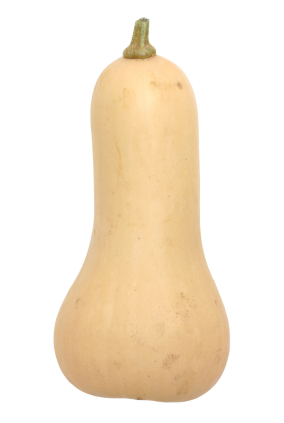
Butternut is one of many different kinds of winter squash, with a distinctive pale yellow and pear-shaped fruit. Inside, the firm flesh is orange and distinctly sweet.
It’s never eaten raw, but the the flesh can be cooked in a variety of ways once the seeds have been scooped out. Baked or roasted is the most common. Being orange inside, its no surprise that butternut squash is very high in vitamin A. You will also get potassium, vitamin C, manganese and a large dose of fiber.
Starting from Seed
Butternut squash need warm soil to germinate so you are better off starting seeds indoors, though you can also direct seed outside once the weather warms up.
Plant your seeds in larger (3″) seed pots rather than flats, with the seeds about an inch under the soil. You can plant 2 or 3 in each pot, to transplant together in hills. Keep your pots somewhere sunny and warm or they may take a long time to sprout. Get them started around 3 weeks before your last frost date.
Each butternut squash plant will produce several large squash, so you won’t likely need more than 3 or 4 plants.
Transplanting
Your seedlings should go out about 2 weeks after your last frost has passed.
Dig your soil to prepare for planting and add fertilizer or compost. Choose a location that will have full sun and allow a lot of space for the vines. Each hill should have 3 feet of space around it.
If you are putting seeds straight into the garden, you’ll be planting them at the same time as you would put out the transplants. They will not germinate or sprout in cold soils. Plant 4 or 5 seeds in a small hill, and thin down to 2 or 3 after they have sprouted.
Butternut can be grown upward on a fence or trellis if you don’t want to have vines all through your garden. If you plan on training them up this way, you can plant your seedlings just 2 feet apart. In this case, don’t plant them in little groups, but rather just one plant every 2 feet. Be prepared to add extra support when those large fruits start to grow.
Growing Instructions
Like cucumbers, squash vines will first have a round of male-only flowers come to bloom before the female ones do. So don’t be alarmed if none of the first blossoms set any fruit. They aren’t supposed to.
For plants growing on a trellis, you will have to take care to protect the squash as they get larger. The plant won’t be able to support them up in the air on its own. Various slings or nets can be fashioned by the creative gardener. Pantyhose, old t-shirts, mesh produce bags can all be used to make a squash hammock. Just tie them to the trellis, not the vines.
As the season comes to a close, pinch off any new flowers and remove very young squash. You can help the plant divert its resources to finishing off the larger squash before winter by not letting any new ones get started.
Containers
Butternut is one of the larger winter squashes and not really ideal for container gardening. A container that is 5 gallons in size or larger would be adequate for 1 plant, though the vines will take up quite a bit more space beyond that. You can trellis container squash, but will have to make sure it is secure as the top-heavy trellis can topple over if it’s just anchored by a pot of soil.
Pests and Diseases
Healthy butternut squash plants can produce many pounds of food for you, but you will need to take care of them first. They are unfortunately susceptible to a number of potential problems.
The broad leaves can be attacked by squash bugs or striped cucumber beetles. Check your plants frequently and pick them off as you find them. They can hide in the blossoms, so look there too. Insecticide sprays can usually help keep them to a minimum. A tent of mesh over your young plants can protect them, just make sure you remove it when the flowers start to bloom.
Vine borers aren’t as obvious and they will eat into the stalks of the plants where you can’t see them. If your plants wilt even thought they are well watered, this is likely the problem. You can use some pesticides before they strike but once they are in your squash plants there is little you can do to save the plants.
Bacterial wilt is another possible cause for wilting plants, and it spread by the cucumber beetle. The leaves closest to the infection point will start to wilt first, and the it will spread through the plant. The vines will start to get misshapen and then die outright. You can’t treat wilt so pay close attention to the cucumber beetles in your garden.
One last threat is the common powdery mildew. You can get a white “powder” coating on the leaves if you get water on them every time you water the plants. Direct the water at the soil and it should prevent this from developing.
Harvest and Storage
On average, each squash will weight around 1 pound and each plant should produce 3 or 4 of them in a season.
As a winter squash, you don’t generally pick butternut until it has fully matured. Summer squash like zucchini are different as they can be picked and eaten while young. Watch for your maturity date, and check the fruits with a fingernail. The skin should be tough enough that a nail won’t cut into it.
A mature squash will be fine after a light frost, but its best if you can get your harvest in before your frost date. After a frost they won’t store as long though they will still cook up just fine.
For squash you are using right away, you can keep them in the refrigerator for up to 2 weeks. Cooked squash can be frozen but it will lose its firm texture after you thaw it out.
To store for a longer period of time, let your squash “cure” out in the sun for a couple of dry afternoons before putting them into storage. You should be able to keep them for a few months in a cool dry place.
88 Responses to “How to Grow Butternut Squash”
Leave a Response
Blog Categories
- Critters & Creatures (20)
- Gardening (222)
- Edible Gardening (60)
- Plant Profiles (32)
- Planting Ideas (40)
- Troubleshooting (48)
- Gardening Coupons & Deals (13)
- Greenhouse Gardening (4)
- Landscape Design (22)
- Pictures (8)
- Reviews (2)
- Videos (5)
Recent Forum Posts 
| Thread Title | Replies |
| hi | 0 |
| savetiktok | 1 |
| Hello all | 0 |
| Онлай... | 0 |
| Hello all | 0 |
| Introduction | 1 |
| Thuja Green Giant | 0 |
| write my philosophy paper for me | 0 |
| I am looking for some advice. | 4 |
| Fruit that's really nice, but not c... | 0 |
|
Members: 3189 | Posts: 3761 Come Join the Discussion Today! |
|
Site Categories
Archives
- December 2020
- December 2019
- November 2019
- January 2019
- April 2018
- February 2018
- December 2017
- November 2017
- May 2017
- April 2017
- September 2016
- July 2016
- June 2016
- April 2016
- March 2016
- February 2016
- December 2015
- November 2015
- September 2015
- June 2015
- May 2015
- April 2015
- January 2015
- December 2014
- November 2014
- October 2014
- September 2014
- July 2014
- June 2014
- March 2014
- February 2014
- December 2013
- November 2013
- September 2013
- July 2013
- June 2013
- May 2013
- April 2013
- January 2013
- December 2012
- November 2012
- October 2012
- August 2012
- July 2012
- June 2012
- April 2012
- March 2012
- February 2012
- October 2011
- September 2011
- August 2011
- July 2011
- June 2011
- May 2011
- April 2011
- January 2011
- December 2010
- October 2010
- September 2010
- August 2010
- July 2010
- June 2010
- May 2010
- April 2010
- March 2010
- February 2010
- January 2010
- December 2009
- October 2009
- July 2009
- June 2009
- May 2009
- April 2009
- March 2009
- January 2009
- December 2008
- November 2008
- October 2008
- September 2008
- August 2008
- July 2008
- June 2008
- May 2008
- April 2008
- February 2008
- January 2008
- November 2007
- October 2007
- September 2007
- August 2007
- July 2007
- June 2007
- May 2007
- April 2007
- March 2007
- February 2007
- November 2006
- October 2006
- September 2006
- August 2006
- July 2006
- June 2006
- May 2006
- April 2006
- March 2006
- February 2006
- January 2006
- December 2005
- November 2005
September 28th, 2012 at 2:16 am
can i grow butternut using chicken manure?
September 28th, 2012 at 2:17 am
can i grow butternuts using chicken manure?
December 10th, 2012 at 2:48 am
Why so many unanswered questions. Is there any kind of spraying program for pumpkin fly ets.
Regards Herman Smith, Louis Trichardt, South Africa
January 13th, 2013 at 12:00 pm
I planted 5 seeds butternut early Nov2012. They are now rampaging thru my garden…I gave up counting the baby ones at seventy odd and plants are still advanceing throwing out beautiful rich yellow dinnerplate sized flowers.Shall I cut the leaders to stop the advance or should I not and allow the entire heighbourhood enjoy to there largesse?
June 27th, 2013 at 4:45 am
Did you know that in Africa and in a small country called Lesotho, we plant butternut squash? We usually have good harvest if we plant in time and water properly.. 8-10 mature butternuts per plant in one season…
I am personally a big fan and consumer…
June 27th, 2013 at 2:59 pm
Should I cut the extra runners off for larger butternut squash?
June 28th, 2013 at 8:38 pm
I am growing butternut squash for the first time this summer. I appreciate the info that I received by reading several statements. But some questions that people asked, don’t have responses under them. How come? I have one plant in a 20 gallon bucket. I noticed runner beginning to grow. Should I move over by fencing. Do I need hay. Are there other options? Is there a difference in male/female blossoms coloring? Thank you Marleen
July 5th, 2013 at 2:47 pm
A lot of people asked the question why a young squash will start to yellow of and die. It just means the female squash blossom was not pollinated. You can avoid this by pollinating the flower yourself with one of the male flowers. Hope that helped:)
August 4th, 2013 at 1:38 pm
What are some good ways to store seeds for next year? And do I need to soak them or what? Thank you!!!
August 9th, 2013 at 2:37 am
For anybody starting out for the first time I thought a few tips might be helpful? The way to differentiate between male and female flowers is that the male is on a long stalk and the female has an embryonic butternut squash attached behind the flower. The way to pollinate by hand is to use the male flower like a paint brush right inside the middle of the female or use a baby bud (Q tip). Alternatively, leave it to Mother Nature.
If the butternuts are not pollinated the flower just dies off, along with the little butternut. Sometimes I find it helpful to pollinate by hand those flowers which don’t have so much access to bees because they are hidden. I try to ease the foliage back, tucking large leaves under others, when there is a flower requiring pollinating. It pays to give them all the help in the world!
Remove the dead flowers and any rotting foliage promptly to avoid disease.
I grow organically and make an organic fertiliser by mixing compost and water in a bucket and then diluting it with water in a watering can. You could use chicken pellet fertiliser or phostrogen/miracle geo also.
I just put plenty of my rotted horse muck/compost into the beds but you can make ‘hills’ by digging a hole a foot deep and two feet wide and mixing in compost with the soil removed.
I start my seeds indoors in little pots covered in cling film plastic. When the seed emerges, remove the plastic. Grow on in the greenhouse but don’t allow the plants to get cold or wet. They hate their leaves getting wet. This summer the weather in England is hot and sunny and the plants are romping away.
I was surprised to find that I had dozens of female flowers and no males for a long time but I have ended up with so many butternuts growing it would be difficult to count. I have seventeen plants so I think we will be eating butternuts all winter.
When they are fully mature (leave on the vine for as long as possible) cut leaving a long length of stalk as they rot from the end of the stalk. Don’t carry by this end or they will suffer. They can be left to ripen in the sun but it is safer in this climate to put in a greenhouse or sunny windowsill for ten days to two weeks.
Store in a frost free place, on loft insulation in the loft space is perfect if a bit tricky to access.
August 10th, 2013 at 10:46 am
I would like to know the answer asked above as to whether if picked green they will ripen off the vine.
Also someone asked what could be used as a trellis. We use cattle panels. They are 16×4 ft and very sturdy. You can bend them into an arch and then plant on both sides and the fruits hang down inside. Amazing. We put 3 up in a row and attached them together with zipties, with 16 ft 2×4 attached with zip ties across the bottom edge of each. Have all my vining fruit growing on this.
August 11th, 2013 at 2:28 pm
Nice trellis idea Liz, but no, they will not ripen off the vine.
September 4th, 2013 at 7:10 am
I have 2 plants in one container though I have small aquashes on them I have trail vines which look out of control can I cut these back to helpon the squash coming through.
Regards
Ernie
September 24th, 2013 at 5:55 am
the fellow from england is reguarding summer asjuly 17 18 not along groing period but anyway i m in florida where it is totaly opposite with what i seem to see that poor polination can lead to dead new squash thankyou and sept.1 is a good time i have found to plant squash ha ve had very good reoults… much better than my spelling dan
October 7th, 2013 at 2:07 am
Iam starting up a small scale commercial farm in Uganda, growing a variety of vegetables. Any ideas how I can be successful?
October 19th, 2013 at 10:56 pm
We live in South Africa. If anybody has any advise on growing butternut here please advice.
Many thanks
October 24th, 2013 at 9:41 am
I’m lucky this year that a butternut squash grow in my garden (Maybe birds planted it).
We can’t believe that this one plant produced more than 10 squashes! Now it is end of Oct in Northern CA, it is still blooming and growing more fruits!
So one happy plant is enough to make you happy!
November 3rd, 2013 at 9:45 am
We have 8-10 lb. butternut squash. They’re light brown with some stripes on them. Any way to let them mature? The weather is getting colder. Our largest is 11 lbs. Is this normal?
January 13th, 2014 at 9:39 pm
I have also planted squash butternuts and now they are beginning to germinate,please may you help me with the kind of pesticides I should use now just as they germinate and also when they begin to flower.
January 13th, 2014 at 9:44 pm
Well said.What insecticides and pesticides can we use at germination and flowering.
January 17th, 2014 at 3:12 pm
what causes butternut not to change colour. 2 how can i prevent the fangue on the butternut. fanguel like dot dot on the butternut
February 16th, 2014 at 9:54 pm
I have tried growing cucumbers with no success because of, of all things, the birds. They don’t care about the cucumbers, but they will pick the vines clean of all the leaves, I have seen them do it. Does this ever happen with butternut squash? I don’t even want to try growing it if the birds are going to win again.
April 11th, 2014 at 1:49 pm
Hi, I notice lots of questions. I am learning as well, and I came across a website that was helpful:
http://squarefootabundance.com/bountiful-trellised-squash/
Hope this helps!
July 16th, 2014 at 8:32 pm
I have several squash growing on about 4 plants, but my butternut squash are very small, less than the length of my hand. Is there any reason mine are so small? They have only started growing about 8 weeks ago, how long should it be until they are ready to harvest?
September 14th, 2014 at 10:46 am
I pick mine green and they ripen off the vine
December 16th, 2014 at 7:56 am
Is it ok to trim off some of the leaves, as it will poss11ibly then send more goodness to the fruit. Do not think trimming off more thad aprox 25% would be good.
December 16th, 2014 at 7:57 am
want to trim off 25% of leaves. Is this OK.
May 28th, 2015 at 6:27 am
Want to grow butternut squash in Ghana for export to Saudi Arabia and UK.
January 4th, 2016 at 11:06 pm
if you have fruit that sets, then turns yellow and falls off while very small, it may be that they are not getting pollinated….
the male flowers are on long stems – the female flowers (that set the fruit) are close to the vine,not sticking way out on a stem- I just pull off a male flower, remove most of the yellow petals leaving just the pollen coated stem and hand pollinate the female flower – I usually have a lot of male flowers so just stick it in the female flower and leave it, and as soon as I can easily get them female flower to open… I have really good success this way, as the bees don’t seem to care much for hunting out the flowers that are usually hidden under big leaves….
February 25th, 2016 at 8:50 am
I’ve been growing butternuts for years and looked for information on increasing yields. I found good tips here on natural and chemical fertilization.
I didn’t see any mention of the problem of cross-pollination. I’ve learned to keep my squash as segregated as possible. My zucchini and butternut once did this. The zucs did ok, but some of the butternuts had greenish stripes and their flavor suffered.
March 5th, 2016 at 5:46 pm
Underripe butternut have stripes and poor flavor, might it have just been that? Pollination generally will not affect fruit yield of the current plant – it’ll only muck things up if you save seeds.
December 21st, 2016 at 2:49 pm
Can butternut squash grow in the Caribbean with tropical climate year round?and if so how long from planting will it take to harvest your squash.
January 5th, 2017 at 4:28 pm
120 days for harvest, and I see no reason why it wouldn’t grow for you.
February 14th, 2017 at 12:46 am
I grow butternut squash here in Hawaii, and it grows fine, so maybe that is help to the person in the Caribbean. I have a couple of plants just making flowers here now and first fruit is set. I can plant them year round here. Sometimes they do best if planted dead of winter or late/summer fall, as it seems that cucumber beetles are worse around late spring. By then, these plants I have growing will have produced already. Have fun.
March 4th, 2017 at 2:01 am
can i use chicken manure to fertilise butternuts and is that sufficient fertiliser
March 12th, 2017 at 2:41 pm
I’ve grown Butternut squash several times, but the vines are always killed by Borers and Squash Bugs about the time the first fruits are maturing, despite daily bug-picking and use of pesticides. One early October, about 8 years ago, I was on a beach at the Mississippi River and a couple of dozen of the biggest Butternuts I ever saw came floating down the river and stranded on the beach. Needless to say, I ate my fill of Butternut squash for a year.
July 24th, 2017 at 10:02 am
I have planted a Butternut squash for the first time here in the UK. The flowers come and a yellow tubar starts to grow to the size of a cricket ball then they just die. Any advice please
August 19th, 2017 at 9:08 pm
To combat borer dont plant squash of any kind until July. To combat squash bugs, seek and destroy. I use duct tape to nab them and their eggs. To make it easier on yourself and minimize the population only plant squash every other year. They hide out over winter and start infecting your new squash plants in the spring. If there are no squash they will die out or go elsewhere. This is difficult if you are in. Community garden. I grow zucchini type squash in a tomato cage and butternut vines up a trellis. It make it easier to inspect the underside of leaves for bugs I or eggs. Good luck. Diligence pays off.